AMD Positions EPYC as a Multi-Purpose CPU Backbone for Agentic AI, Cites Venice Benchmark Lead Over Nvidia Vera
The AMW Read
AMD reiterates its known AI-infrastructure positioning with a new Venice-vs-Nvidia-Vera CPU benchmark claim, an incremental update rather than a structural shift.
AMD Positions EPYC as a Multi-Purpose CPU Backbone for Agentic AI, Cites Venice Benchmark Lead Over Nvidia Vera
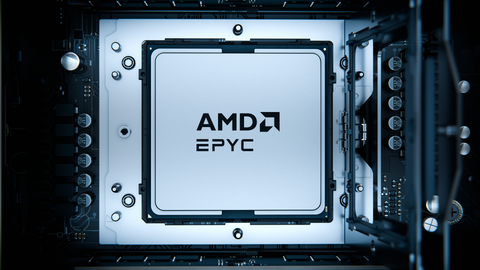
AMD published a new whitepaper, "2026: AMD EPYC Server CPU Architecture and Performance Overview," alongside a companion blog post titled "EPYC CPUs Deliver for Every Layer of the Agentic AI Stack." The material argues that agentic AI systems bundle several distinct CPU-bound tasks into a single workflow — orchestration, retrieval, application integration, and GPU hosting — and that no single fixed architecture serves all of them equally well. AMD says its latest EPYC generation is built to be reconfigured across general-purpose, enterprise, cloud-native, HPC, and AI workloads rather than tuned for one. The whitepaper includes a new benchmark claim: a 96-core "Venice" EPYC processor delivered 1.2x the per-core performance of Nvidia's Vera CPU on the SPECrate 2026 Integer test.
The framing matters because agentic AI deployments route real work through the CPU even when GPUs handle the model inference itself — orchestration layers, tool calls, and retrieval pipelines all run on host processors, and GPU hosting itself is a CPU-dependent function. That keeps CPU architecture a live competitive question inside AI infrastructure buildouts, even as GPU capacity dominates most spending conversations. By naming Nvidia's Vera directly in a per-core comparison, AMD is contesting ground where Nvidia has been expanding beyond accelerators into its own CPU line for GPU-hosting nodes, rather than ceding the host-CPU layer as a commodity decision made after the GPU choice.
For infrastructure buyers and investors, the practical signal is that CPU selection for GPU-hosting racks is becoming a distinct line item in agentic AI deployments rather than an afterthought behind accelerator procurement. Whether AMD's Venice-vs-Vera benchmark claim converts into actual design wins depends on hyperscalers and neo-clouds that may already be standardizing on Nvidia's bundled CPU-GPU rack architecture — worth tracking in AMD's next server-chip disclosures and any customer design-win announcements that follow.