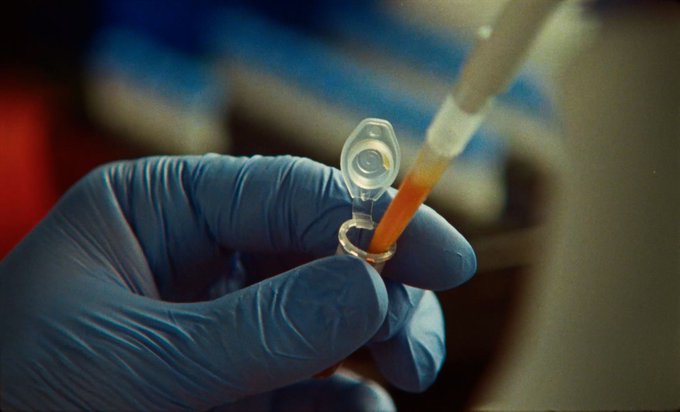
Anthropic says Claude helped its scientists discover a new enzyme system with CRISPR-like properties inside its Bay Area wet lab.
The AMW Read
First named output from Anthropic's newly confirmed wet lab extends its case-study trajectory, and explicit biosecurity-risk framing via Frontier Red Team staff's personal biodefense investment is a genuine safety-as-industry-force signal.

Anthropic says Claude helped its scientists discover a new enzyme system with CRISPR-like properties inside its Bay Area wet lab.
Anthropic's in-house life-sciences team and Claude mined large DNA databases and identified a new enzyme system the company named "Array-related Reverse Transcriptase" (ART), built around a reverse transcriptase core with CRISPR-like repetitive DNA sequence patterns and additional proteins of unknown function. CEO Dario Amodei announced the finding on X on September 23, calling its precise function and biotechnological utility still unclear but describing it as a candidate mechanism for next-generation gene-editing tools. The workflow had researchers propose directions while Claude combed medical literature and genomic data and suggested experiments to test them.
The result is the first named output from the Bay Area wet lab Anthropic confirmed days earlier, where robotic equipment runs experiments with minimal human intervention. It lands alongside continuing pharma partnerships with Novartis, Roche and Novo Nordisk, a September 22 tie-up with OpenEvidence delivering free clinical-decision AI tools to clinicians across roughly 100 low- and middle-income countries including Uganda, Sudan and Haiti, and a personal-capacity seed investment by Frontier Red Team lead Logan Graham and technical staff member Sholto Douglas in Pilgrim, a biodefense startup building airborne-pathogen detection hardware. Per the AI Market Watch index, Anthropic carries $132.3B in total tracked funding (coverage, not a census) — capital depth that lets it run lab, distribution, and biosecurity bets in parallel rather than sequentially.
For investors, the enzyme claim itself is unproven science, not a product — the nearer-term signal is a biotech distribution channel (pharma deals, OpenEvidence reach) forming ahead of Anthropic's expected IPO. For builders and policy watchers, frontier-lab safety staff personally funding biological-threat-detection hardware signals that AI-enabled biosecurity risk is being treated as material enough to hedge individually, not just flagged internally.