Antioch launches as a 'physical AI Cursor' to enable rapid robot software iteration. Announced via a...
The AMW Read
Antioch's 'physical AI Cursor' introduces a novel developer-tool layer for robotics, building on its prior funding but pivoting to a product that could reshape the segment.

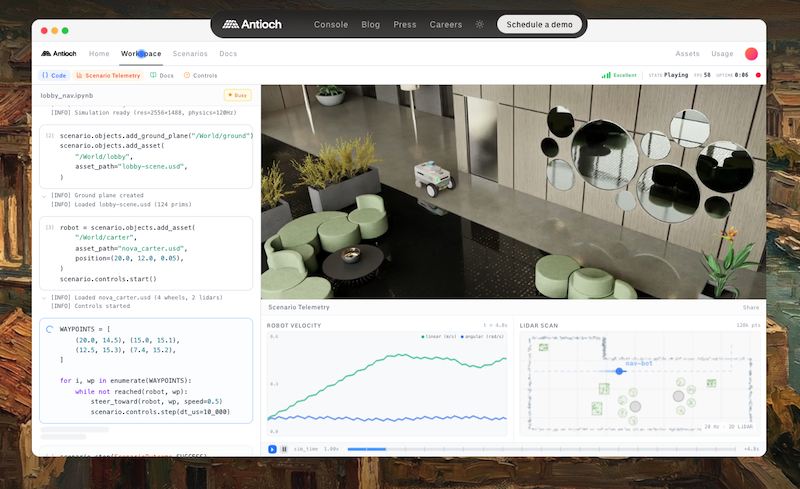
Antioch launches as a 'physical AI Cursor' to enable rapid robot software iteration. Announced via a technical briefing, the startup is positioning its product as a development environment for roboticists, analogous to how Cursor streamlined AI-assisted code editing. The tool targets the inner-loop workflow of robot software: simulation, testing, and iteration, aiming to shorten the cycle from code change to validated behavior. The announcement emphasizes continuous calibration and CI/CD-style testing for physical AI, building on the foundation established in its $32M Series A led by Greylock in September 2026. Per the AI Market Watch index, the company has raised $44.1M to date (coverage limited to index-tracked companies).
This launch signals a critical market shift: the bottleneck in robotics is moving from hardware to software iteration. As embodied AI models become more capable, the ability to test and refine them quickly in simulation becomes a competitive moat. By positioning itself as the 'Cursor for physical AI,' Antioch is staking a claim in the developer-tools layer of robotics, a space that has lagged behind the maturity of AI coding tools. This is a direct bet that the next wave of AI infrastructure will be about the development experience, not just the underlying models or compute.
For builders and investors, the implication is clear: the tools that compress iteration time for robotics will capture outsized value. If Antioch can deliver on its promise of continuous calibration and CI/CD-style testing, it could become the default environment for robot software teams, much like Cursor became the default for many AI developers. This validates a growing pattern where vertical AI tools are being rebuilt around developer workflows rather than just model APIs, and suggests that the $44.1M invested so far may be seed capital for a much larger market opportunity.