OhpiNeuro Develops Ultra-Low-Power Neuromorphic AI Chip for Edge Devices
The AMW Read
New edge-AI chip entrant with a pre-production neuromorphic roadmap and no disclosed funding, customers, or shipping silicon, updating the hardware player map without shifting segment dynamics.

OhpiNeuro Develops Ultra-Low-Power Neuromorphic AI Chip for Edge Devices
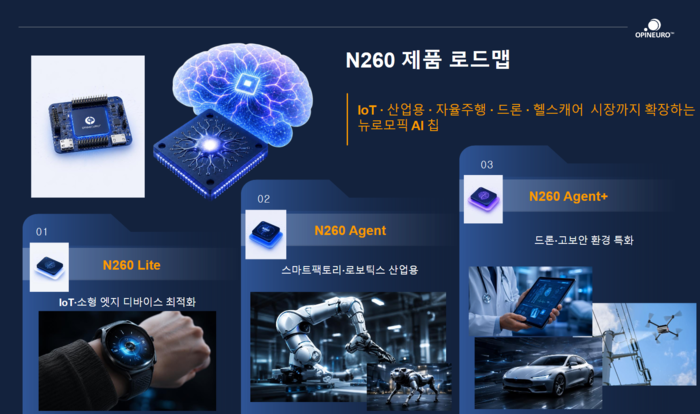
OhpiNeuro, a South Korean AI semiconductor startup, is developing a neuromorphic AI processor line called N260 built on spiking neural network (SNN) architecture that computes only when input data changes, aiming to cut the power draw of conventional always-on AI chips. The first chip, N260 Lite, targets a maximum power consumption under 0.7W, a sub-28-nanometer process node, and a footprint under 5x5mm, aimed at smart cameras, industrial IoT sensors, intelligent sensors, drones, and mobile robots, with development completion targeted for the second half of 2027. A follow-up chip, N260 Agent, is set to begin development in the first half of 2027 using DX-MRAM (DX-TR-based MRAM) memory technology intended to raise memory density and energy efficiency for on-device AI agents and larger on-device models. OhpiNeuro was also selected for South Korea's 2026 Super Gap Startup Project (DIPS), run by the Ministry of SMEs and Startups, which supports prototyping, proof-of-concept testing with global customers, and partnership development.
Edge inference power budgets increasingly determine where AI models can physically run: drones, industrial sensors, and mobile robots lack data-center-scale power and thermal headroom, and conventional digital accelerators consume power every clock cycle regardless of whether inputs have changed. Event-driven neuromorphic computing is one of several architectural bets on solving that constraint, and OhpiNeuro is pairing it with a proprietary memory approach, betting that memory bottlenecks, not compute efficiency alone, gate how much on-device AI capability edge hardware can support.
For builders targeting edge deployment in robotics, IoT, or on-device agents, OhpiNeuro is a chip to track rather than design around yet: no chip has shipped, no funding or customers are disclosed, and both products carry 2027 completion targets. Investors should read the DIPS selection as a government validation signal, not a commercial one; the real test is whether PoC engagements convert into paying customers once N260 Lite samples are available.