Rebellions Joins KT-Led Consortium for South Korea's 'Modu-ui AI' National Platform
The AMW Read
A government-anchored national AI platform validates Rebellions' NPU at sovereign-infrastructure scale, a step up from its prior single-enterprise KB Financial deployment.

Named counterparties: Upstage
Rebellions Joins KT-Led Consortium for South Korea's 'Modu-ui AI' National Platform
KT announced it is assembling a domestic full-stack AI consortium for the South Korean government's public-facing "Modu-ui AI" ("Everyone's AI") service, combining Korean AI infrastructure and model providers under one operation. On infrastructure, Rebellions supplies its domestic NPU, Lablup contributes AI compute-resource orchestration, and VesslAI Korea provides a dev-and-ops platform. The model layer draws on Upstage, Motif Technologies, NC AI, Saltlux, and Actionpower. KT layers its nationwide telecom network, cloud data centers, and large-scale operations experience on top, and plans an "AI orchestration" system tying every participant's technology into one production service.
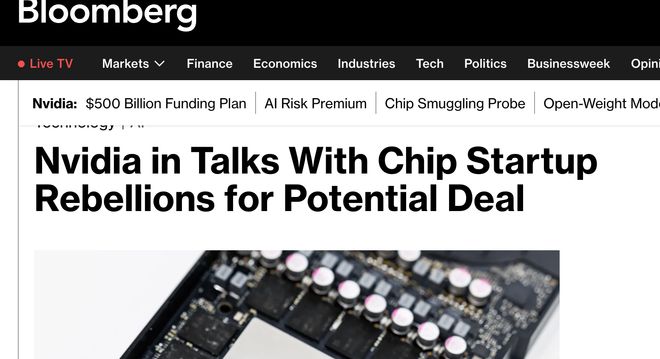
The deal places Rebellions' NPU inside a state-anchored deployment rather than a single enterprise pilot, a step up from its earlier on-premise NPU supply deal with KB Financial Group. It lands as South Korea pushes to reduce dependence on foreign GPUs and models for public AI services, and the same week Rebellions is reportedly in early NVIDIA talks over a possible inference-chip collaboration — a government reference deployment gives it leverage independent of how those talks land. Per the AI Market Watch index, Rebellions logged 8 pipeline-tracked news items in the last 90 days versus 4 in the prior period (name-matched, pipeline-ingested coverage only), consistent with momentum converting into deployments rather than just headlines.
For investors, KT's orchestration model is a template other Korean telcos competing for the same government program may replicate, so Rebellions' inclusion here could recur across additional consortia rather than stay one-off. For builders, the multi-vendor split — separate NPU, compute-ops, dev-platform, and model vendors under one orchestration layer — shows domestic AI stacks in Korea being assembled compositionally rather than through single-vendor lock-in, worth tracking as a procurement template for other sovereign-AI markets.