Meta launches 'Muse Image' AI generator across Instagram, WhatsApp, raising user-data privacy concerns
The AMW Read
Adds a major hyperscaler player to the generative media segment with a novel agentic architecture and a privacy-triggering distribution strategy; updates the hyperscaler-distribution moat pattern.
Meta launches 'Muse Image' AI generator across Instagram, WhatsApp, raising user-data privacy concerns
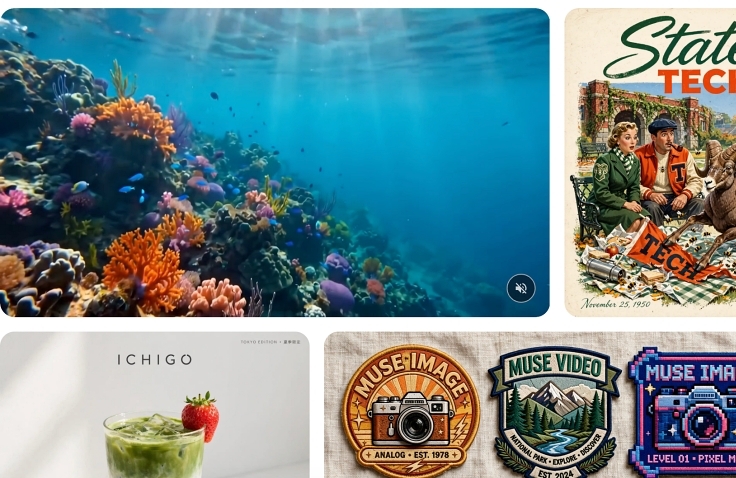
Meta has launched 'Muse Image' (뮤즈 이미지), an AI image generation model developed by Meta Super Intelligence Labs. The model is available inside Meta AI, Instagram Stories, and WhatsApp in select markets, with Facebook access arriving soon. Muse Image operates on an agent-based architecture — rather than mapping prompts directly to pixels, it calls search and coding tools to produce self-improving images. It is integrated with Meta's multimodal reasoning model Muse Spark and uses reinforcement learning to write code that renders accurate graphics, QR codes, and interactive content. Users are offered free access up to a usage cap, with paid tiers beyond that.
Why it matters: Muse Image updates the hyperscaler-distribution moat pattern (segment §5) — Meta is embedding a state-of-the-art generative media tool directly into its existing billions-user social graph, bypassing the standalone-app distribution bottleneck that rivals like Midjourney or Stable Diffusion face. The feature that allows Instagram users to tag any public-profile account and use their images as input for generation — without notification to the tagged user — activates a recurring tension in the multimodal/generative media segment: the boundary between platform utility and user-consent. This is the first media-generation model released by Meta's newly formed Super Intelligence Labs, signaling a strategic push to own the image-creation layer inside social surfaces.
Expert take: The agentic architecture is notable — Muse Image uses code generation and web search at inference time rather than relying solely on latent diffusion, which may yield higher correctness for structured outputs like text-in-image or QR codes. However, the privacy posture is the real market signal: Meta is effectively treating all public Instagram images as training or style-reference inputs for third-party generations. Under its current policy, the image owner receives no notification. This approach could accelerate adoption by reducing friction, but it also invites regulatory scrutiny under GDPR, Brazil's LGPD, and similar frameworks that require opt-in consent for processing of biometric or likeness data. For AI Market Watch, this is a live test of whether platform-scale social graph + generative AI can co-exist with emerging global consent standards — an open debate we track in the multimodal media segment.