Cursor to Lose OpenAI Model Access by November 12 as Musk Feud Escalates; Anthropic Fills Gap
The AMW Read
Adds specific quotes and a confirmed cutoff date to an already-reported OpenAI-Cursor model access dispute, while Anthropic's explicit compute commitment illustrates segment-level model-access dependency risk for AI coding tools.

Named counterparties: OpenAI, SpaceX
Cursor to Lose OpenAI Model Access by November 12 as Musk Feud Escalates; Anthropic Fills Gap
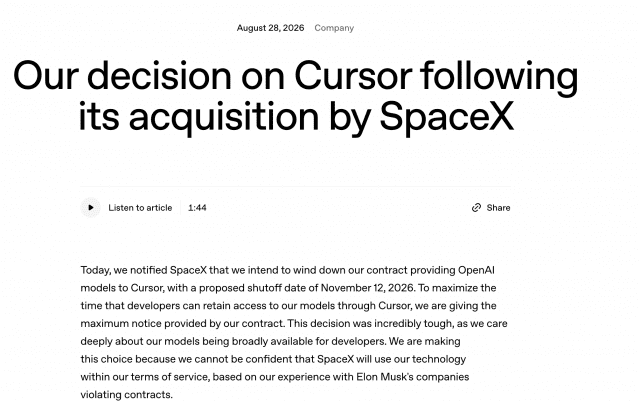
OpenAI notified SpaceX on August 28 that it will wind down model access for AI coding startup Cursor, with the cutoff set for November 12, 2026 — the maximum notice period allowed under their contract. OpenAI said future models, including its next-generation Astra, will not be made available to Cursor, citing a lack of confidence that SpaceX would honor usage terms given past violations by Elon Musk-controlled entities, including X's use of OpenAI models in training Grok, which Musk admitted to in court testimony. Musk responded on X with insults aimed at Sam Altman and Greg Brockman, repeating his claim they "stole" a nonprofit. Cursor CEO Michael Truell said OpenAI models account for roughly 5% of Cursor's total user traffic and that Cursor is working with OpenAI's team to resolve the dispute, noting it had expected OpenAI to act as neutral infrastructure.
The episode turns a personal rivalry between Altman and Musk into direct leverage over API distribution, showing that a lab's terms of service can become a wedge issue the moment a customer's ownership changes via acquisition. For AI coding tools built on multi-model routing, it exposes how much of the product depends on maintaining access across labs rather than any single model's edge. Anthropic is treating the cutoff as a distribution opening: co-founder and Chief Compute Officer Tom Brown said Anthropic will keep expanding compute capacity for Claude inside Cursor, calling it a trusted partner since the Claude 3.5 Sonnet era.
For builders relying on third-party model APIs inside a product, change-of-control clauses in model-supply contracts are now an operational risk, not boilerplate — an acquisition or ownership shift can trigger an access review with only a contractual notice window to adapt. Investors evaluating AI coding platforms should weight multi-model redundancy as a resilience metric, since a dependency covering just 5% of traffic was enough to force a public scramble and a competitor response.