RableUp releases Korean-trained draft model for faster GLM-5.2 inference
The AMW Read
The release incrementally extends an infrastructure provider's inference capabilities, with demonstrated token-acceptance improvements limited to tested Korean workloads and no quantified end-to-end speed or cost gains.

Named counterparties: Z.ai
RableUp releases Korean-trained draft model for faster GLM-5.2 inference
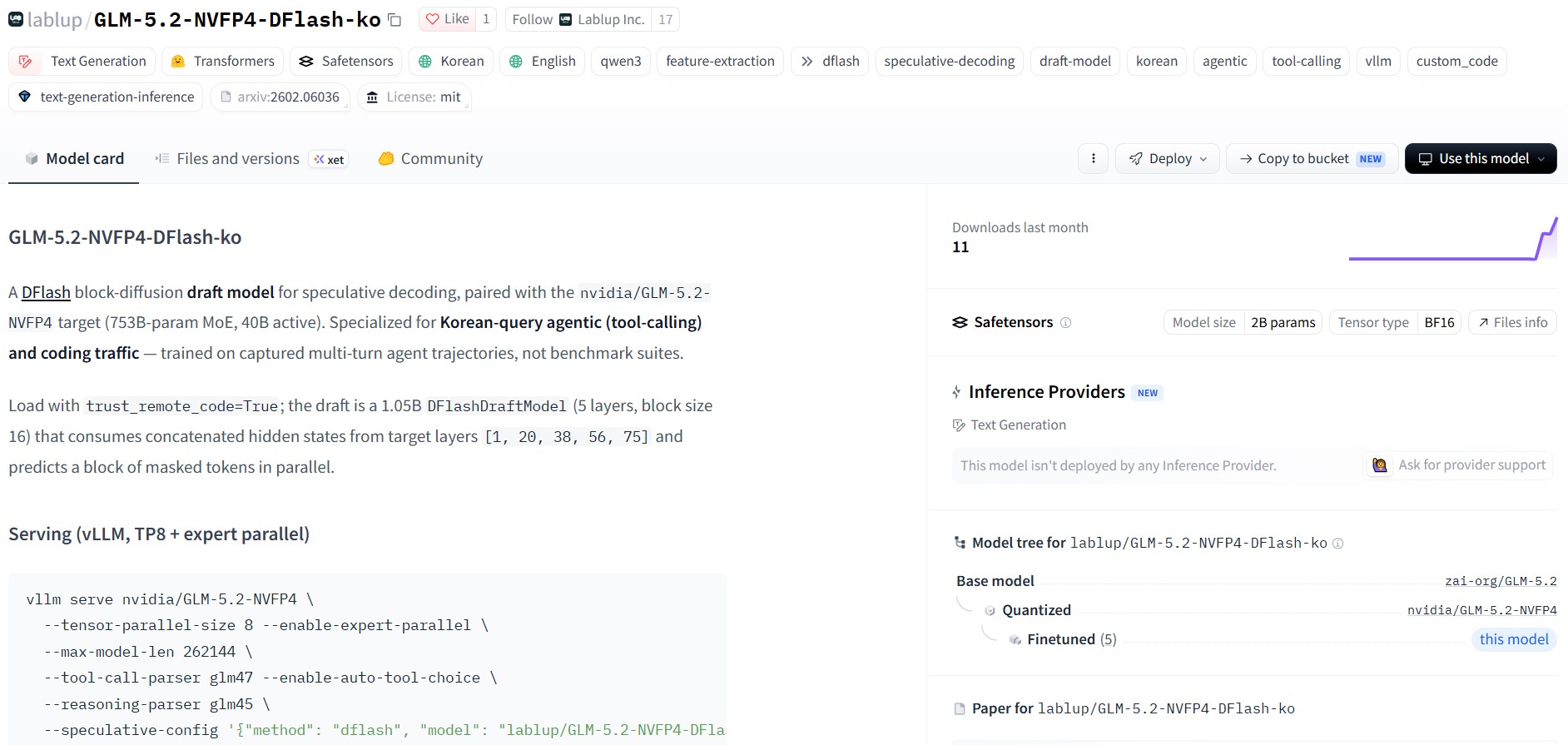
AI infrastructure software company RableUp released GLM-5.2-NVFP4-DFlash-ko on Hugging Face on October 9. The open-source auxiliary model works with Z.ai's GLM-5.2 and uses DFlash to propose multiple tokens for the larger model to verify through speculative decoding. RableUp reports that tests using actual Korean-language agent usage data produced slightly more than 2.7 accepted tokens per verification, compared with averages in the one-token range when using an English-trained draft model for Korean workloads.
The release addresses a language-specific bottleneck in inference software: acceleration depends on how closely a draft model's predictions match the target model, so English training does not necessarily deliver equivalent gains in Korean. This positions RableUp's work in the serving layer, where workload-specific optimization can improve the usefulness of existing open models. The reported acceptance rate is evidence of better prediction alignment on the tested workloads, but it does not establish an equivalent increase in end-to-end response speed or a quantified reduction in serving costs.
Builders evaluating the model should measure latency and throughput on their own Korean workloads before making deployment decisions. RableUp is also developing a Korean draft model for GLM-5.3-Flash and training an approximately 11-billion-parameter Korean diffusion language model from scratch, targeting offline agent tasks on personal devices. That training uses a cluster of 64 Nvidia B200 GPUs, with some GPUs supported through a South Korean government program. These separate efforts broaden its model-development scope; the immediate deployment opportunity is the released GLM-5.2 companion model.