Reflection AI unveils Beam with open weights planned for October
The AMW Read
Reflection's first model meaningfully updates the Western open-weight competitive landscape, but its claimed efficiency and reasoning parity require independent validation before supporting structural conclusions.

Reflection AI unveils Beam with open weights planned for October
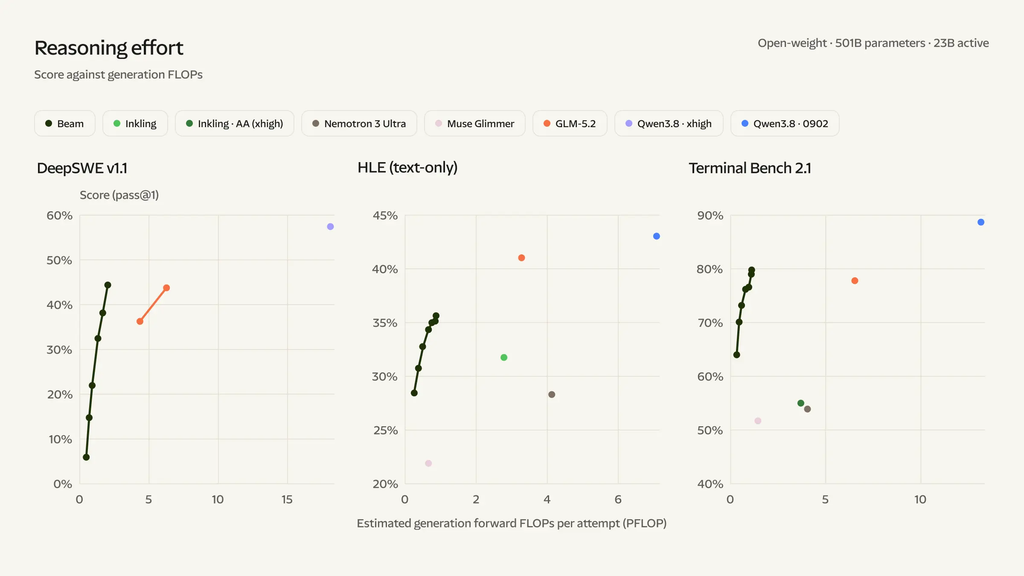
Brooklyn-based Reflection AI has announced Beam, its first frontier model, with weights and full technical details due later this month. The text-only mixture-of-experts model has 501 billion total parameters, 23 billion active parameters, and a 1 million-token context window. Reflection says Beam matches Z.ai's GLM-5.2 on advanced reasoning benchmarks while using three to four times less inference compute. Those results have not been independently verified; the announcement precedes the planned weight release.
Beam adds a Western contender to the open-weight market served by DeepSeek, Qwen, and Z.ai. Its competitive proposition combines reasoning performance with lower serving costs and institutional control over deployment. Reflection is targeting enterprises and sovereign nations with customized, local systems trained on proprietary data, and has begun testing an AI factory partnership with South Korea's Shinsegae Group. Lower claimed inference requirements coexist with substantial upstream commitments: Reflection signed deals collectively worth more than $7 billion with SpaceX and Nebius for access to Nvidia GB300 chips through 2029. Serving efficiency and the capital required to develop frontier models remain distinct questions.
For builders, the concrete next step is to evaluate the released weights against representative reasoning, coding, and agentic workloads before accepting the cost claims. Beam's reported coding advantage over Thinking Machines Lab's Inkling covers four tests with results from both companies, while Inkling is multimodal and Beam is text-only. Deployment economics will depend on measured performance, serving requirements, and integration fit. Planned distribution through hyperscalers and neoclouds could broaden access, but adoption remains unproven.