Reflection previews Beam ahead of its planned Apache 2.0 release
The AMW Read
Reflection's first model gives substance to its deliberate open-weight strategy and updates the foundation-model player map, but restricted access and unverified efficiency claims limit its demonstrated impact.

Reflection previews Beam ahead of its planned Apache 2.0 release
Reflection AI unveiled Beam on October 5, previewing its first model trained from scratch for coding and agent tasks. The U.S. startup says the model has 501 billion total parameters but activates 23 billion per token through a mixture-of-experts architecture. Access is initially limited to selected waitlisted users while final safety checks and evaluations continue. The company plans to publish weights, a technical report, and model documentation under Apache 2.0 this month.
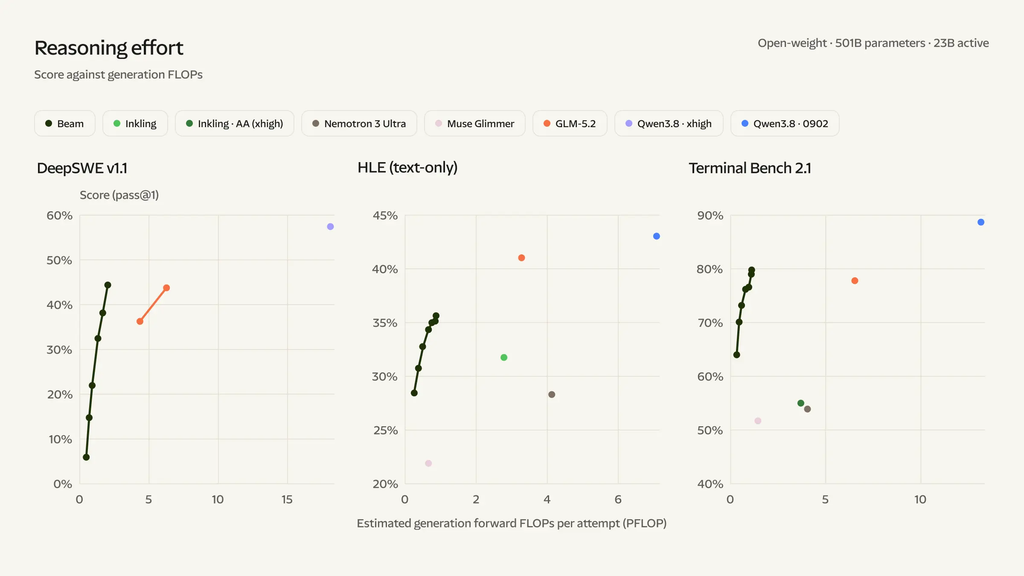
Beam gives Reflection a concrete model behind its shift from autonomous coding agents toward U.S. open-weight competition with Chinese labs. It extends our October 4 coverage of its planned open-weight offering, although deployment readiness remains unproven. Reflection reports reasoning scores comparable to Z.ai's GLM-5.2 at one-third to one-quarter of its estimated generation compute, with coding and agent results competitive with GLM-5.2 and approaching Alibaba's Qwen 3.8-Max. It also acknowledges that Moonshot AI's Kimi K3 performs better. This positions Beam around permissive access and computational efficiency rather than a claimed overall performance lead.
Builders should test serving requirements before treating that compute estimate as a cost advantage. Reflection's calculation uses active parameters and generated tokens, excluding input processing and service overhead; the full parameter set still carries storage and memory demands. Training also required substantial resources: 6,144 Nvidia GB300 GPUs for pretraining on 23.8 trillion tokens in under four weeks, followed by four weeks of reinforcement learning on 10,500 GB300 GPUs. The planned weight release would enable external checks of both benchmark claims and practical deployment economics.