HyperAccel details pooled-resource architecture for Korean AI data centers
The AMW Read
The roadmap incrementally updates a domestic infrastructure consortium, with segment-level potential through data-center resource allocation and chip architecture, but integrated performance remains unproven.

HyperAccel details pooled-resource architecture for Korean AI data centers
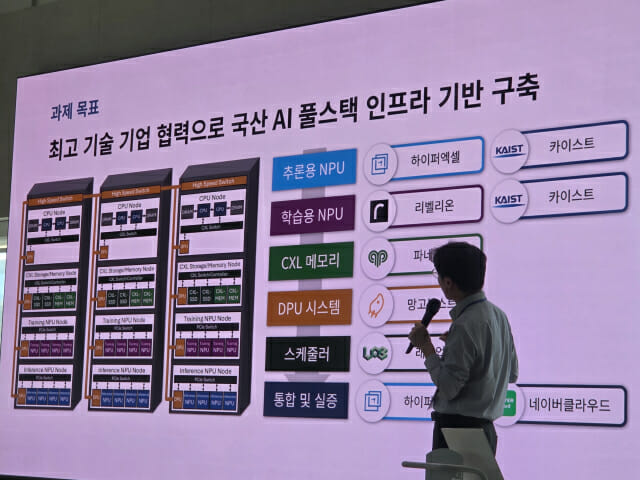
HyperAccel presented its K-Composable Cluster roadmap at K-Cloud Tech Day 2026 in Seoul on October 27. The national project runs from April 2025 through December 2030, with a 45.8 billion won budget, including 34.8 billion won in government support. HyperAccel leads the effort with Rebellions, Panmnesia, MangoBoost, Lablup, KAIST, and Naver Cloud. The plan separates processing, memory, and CPU resources into pools that software can allocate dynamically to workloads.
The market question is whether coordinated hardware and scheduling can improve utilization enough to ease data-center power and cost constraints. HyperAccel supplies inference processors, while partners contribute training NPUs, CXL memory, DPU communications, scheduling, and simulation. This places the project at the intersection of alternative AI silicon and cluster orchestration. HyperAccel also described its Bertha LLM Processing Unit, reporting 192GB of LPDDR5X memory, a 250W card power rating, and memory-bandwidth utilization of up to 90%. These specifications describe its hardware approach; they do not establish cluster-level savings.
For builders and investors, the concrete checkpoint is integrated operation under representative workloads. The roadmap calls for single-node integration in years one through three, followed by multi-node integration in years four through six. Naver Cloud and SKT are named as demand-side partners for validation and commercialization. The planned hybrid LPU/GPU architecture targets up to three times system throughput. Buyers should assess that target alongside measured power, utilization, and deployment costs when integrated results become available.
