Kakao-LG Consortium Unveils 'Everyone's AI' Service Design Built Into KakaoTalk
The AMW Read
Extends Kakao's prior government AI-agent contract win into a detailed KakaoTalk-native consortium product with sovereign-model requirements and national adoption targets.
Kakao-LG Consortium Unveils 'Everyone's AI' Service Design Built Into KakaoTalk
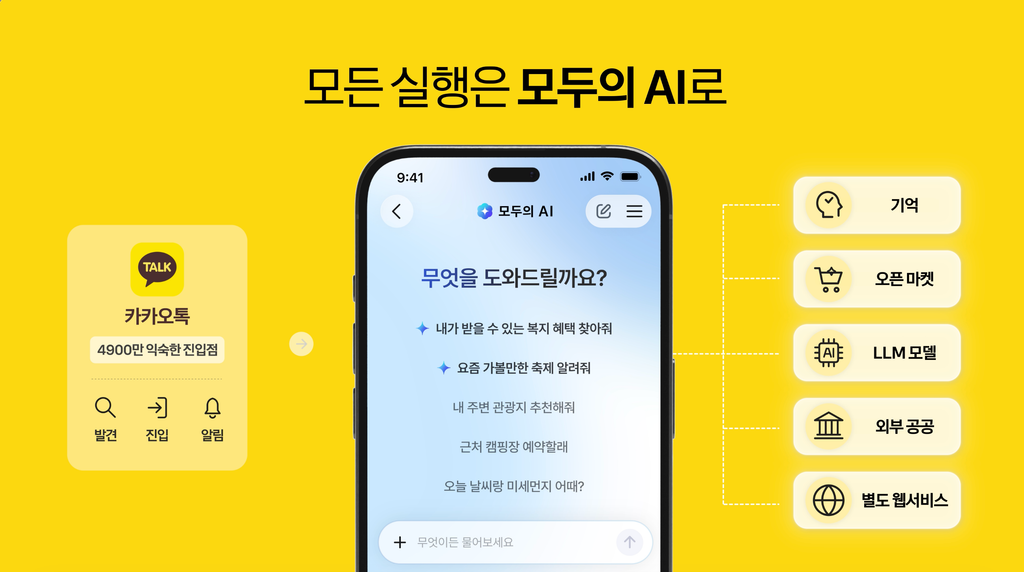
Kakao and four LG Group affiliates disclosed the design of South Korea's 'Everyone's AI' national service on September 4, following last month's selection of Kakao's consortium alongside SK Telecom and KT as government contractors. Kakao leads planning, development and operations, with KakaoTalk as the entry point instead of a separate app; Kakao Enterprise runs the AI cloud and data-center infrastructure. LG's four units split the rest: LG Uplus extends reach through phone-based AI, LG AI Research supplies the model, LG Electronics links home appliances, and LG CNS handles public-sector data integration. The service runs on Kakao's Kanana and LG AI Research's K-EXAONE, chaining search, application and execution for public services including Gov24 and the AI National Assistant, starting with jobs, finance, health care and life-care.
The program is a state-directed distribution bet — routing a national AI assistant through a base Kakao puts at 50 million users, built on domestic models rather than foreign frontier ones. Per the AI Market Watch index, Kakao logged 21 pipeline-matched stories in the past 90 days versus 12 in the prior 90 (name-matched over pipeline-ingested sources only), consistent with a consortium now running multiple government-linked AI tracks in parallel. A planned opening of Kakao's PlayMCP registry to outside developers points toward an agent marketplace layered on the same KakaoTalk channel once the bundled assistant ships.
For builders, PlayMCP's planned opening is the practical hook: a registration path into a government-backed assistant already sitting on a pre-built messaging user base, rather than a product requiring separate distribution. For investors, the near-term signal is adoption against stated targets — 5 million monthly active users by December, 10 million by end-2027 — which will show whether bundling AI into an incumbent super-app converts differently than a standalone consumer AI product.