Guanglian Xinke hits $1B valuation after nearly RMB 1.5B in two 2026 rounds for chip-level optical I/O
The AMW Read
First China OIO unicorn updates the AI-infra player map; primary subject is silicon-photonics chip and co-packaged optical hardware for AI scale-up, not a mega-round capital event.
Guanglian Xinke hits $1B valuation after nearly RMB 1.5B in two 2026 rounds for chip-level optical I/O
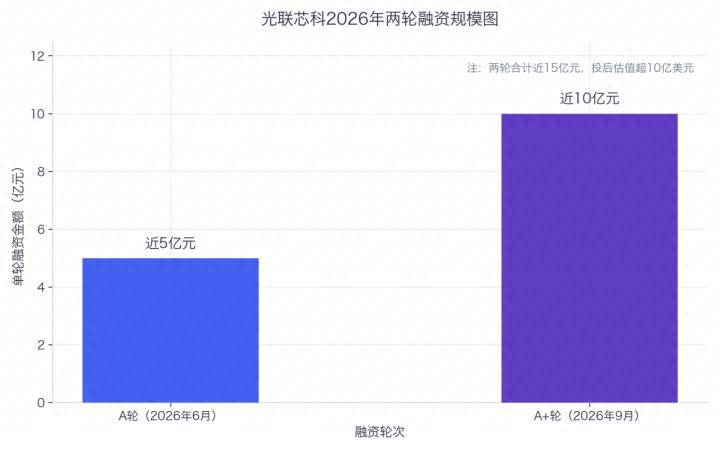
Beijing-based Guanglian Xinke (光联芯科) said it closed an A+ round of nearly RMB 1 billion (~$140M), lifting its post-money valuation above $1 billion and making it the first unicorn in China's optical input/output (OIO) interconnect category. The raise followed a June 2026 Series A of nearly RMB 500 million (~$70M) by less than three months, for combined 2026 funding of nearly RMB 1.5 billion (~$210M). A+ investors included China Life Capital, China Merchants Capital, Xinglian Capital, CITIC Securities' investment arm, and Henan Huirong, with Sequoia China, Hillhouse, and Junlian Capital among returning shareholders. Founded in February 2024, the company builds silicon-photonics chips and co-packaged optical engines for HPC and AI clusters, moving electro-optical conversion inside the package to cut PCB losses versus pluggable optics.
The round arrives as AI scale-up fabrics strain copper and pluggable modules and push toward CPO and deeper in-package optics. Nvidia's Spectrum-X Ethernet Photonics CPO switches are entering production with early cloud adopters, Broadcom's 51.2T Bailly CPO is shipping in small volumes, and North American hyperscaler CapEx remains heavy. Guanglian Xinke frames OIO as the next step after LPO, NPO, and CPO—placing conversion nearer GPU, CPU, and XPU packages—and says it has developed a domestic 12-inch silicon-photonics process aiming to volume-produce 3.2T–32T microring chips on 12-inch wafers in the third quarter of 2026, plus programmable lithography for microring wavelength trimming. That inserts a two-year-old Chinese vendor into a capital race that already includes listed peer Xizhi Technology and startups mapping NPO to CPO to OIO.
For builders and investors, the test is yield, cost, standards, and customer qualification as OIO leaves demos for volume. Guanglian Xinke is pitching standardized optical interfaces for domestic GPU makers as an open alternative to vertically integrated Nvidia and Huawei interconnect stacks; whether that coalition becomes a de facto standard will decide if the valuation becomes design-win influence. Near-term markers are the 12-inch microring ramp, thermal locking of NPO engines under GPU-like heat, and whether Scale-up optical attach rates actually raise optics content per AI cabinet as copper runs out of headroom.