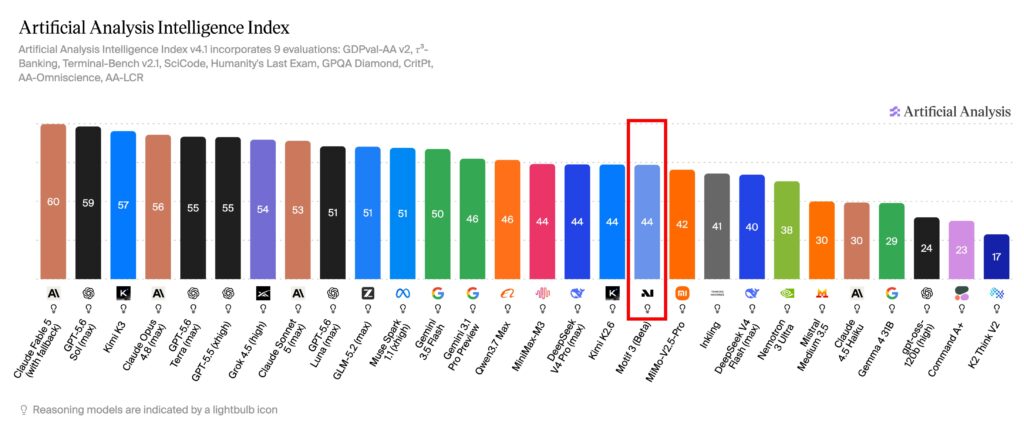
Motif Technologies’ self-designed LLM ‘Motif-3’ scores 44 on AAII benchmark, tying DeepSeek V4 Pro (Max)
The AMW Read
Incremental update to known landscape: new entrant in foundation model segment with competitive benchmark result; significance at segment level due to efficiency claim and sovereign compute angle.

Motif Technologies’ self-designed LLM ‘Motif-3’ scores 44 on AAII benchmark, tying DeepSeek V4 Pro (Max)
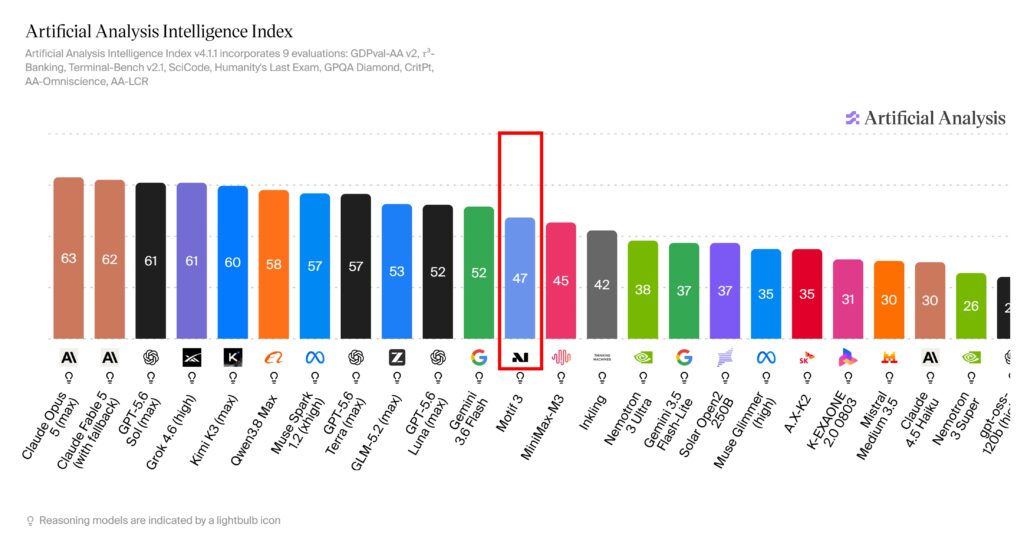
Motif Technologies, a South Korean AI startup, released interim results for its large language model Motif-3, currently being developed under the government’s Independent AI Foundation Model (Dokpamo) project. The 314-billion-parameter beta version scored 44 on the AAII benchmark from Artificial Analysis, tying DeepSeek’s V4 Pro (Max). The model uses a Mixture-of-Experts architecture with 13 billion active parameters per token. The company claims Motif-3 was designed from scratch rather than fine-tuned from an existing open-source model, and was trained with approximately 700 GPUs provided by the government over a five-month period. The weights are publicly available on Hugging Face, though commercial use requires written permission.
Why it matters: This development updates the capital-compression dynamic in the foundation model segment, where smaller, later-entering players claim frontier competitiveness with far fewer resources than incumbents. Motif, with just 30 staff and 5 months of compute at modest scale, places itself within 3–5 months of leading models according to its own analysis. This echoes the pattern of DeepSeek’s own rise — disproving capital barriers through architectural efficiency — but adds a new variable: government-sponsored compute (the Dokpamo project) as an alternative to hyperscaler-distribution moats. The open-weight release also continues the structural shift toward public availability of capable models, pressuring closed API pricing.
The grounded expert take: The comparison to DeepSeek V4 Pro and earlier models like Anthropic Opus 4.6 and Moonshot Kimi 2.6 should be interpreted cautiously — AAII is a composite benchmark, and the same total score can mask differences in reasoning, coding, or domain-specific capability. True validation of Motif’s architectural claim will require systematic reproducibility by third parties. However, the signal is clear: the speed of frontier compression continues to accelerate, and late entrants with efficient MoE design and sovereign compute backing can produce genuinely competitive models. This will factor into debates around whether emerging-market labs need hyperscale GPU clusters to matter, or whether architectural innovation can partially substitute for raw compute.