Xcena raises $135M Series B for in-memory AI chip targeting inference bottlenecks
The AMW Read
Novelty=1 because Xcena is a new entrant in AI silicon but the in-memory inference approach is an incremental variation on existing specialized-chip stories. Significance=1 because the $135M round and narrow KV-cache focus limit near-term segment impact absent hyperscaler adoption.

Xcena raises $135M Series B for in-memory AI chip targeting inference bottlenecks
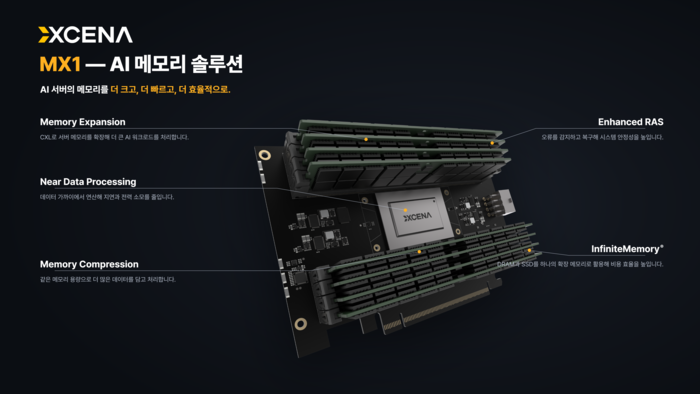
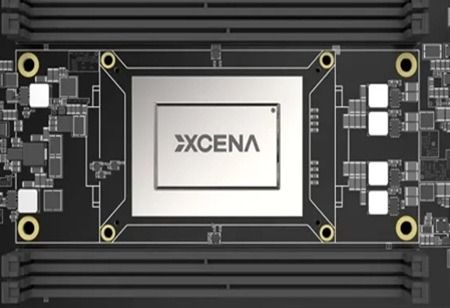
Xcena, developer of the MX1 chip that performs data orchestration and KV cache management directly within memory modules, has closed a $135 million Series B round. The company states the funding will be used to scale production of its AI infrastructure chip, which is designed to reduce memory bottlenecks during large-model inference by handling key-value cache operations at the memory level rather than shuttling data between separate compute and memory units.
Why it matters: Xcena is entering the AI infrastructure segment at a moment when inference efficiency — particularly KV cache management for long-context reasoning models — has become a critical cost and latency driver. Rather than building a general-purpose accelerator, Xcena targets a narrow but rapidly growing pain point: the memory wall that emerges when serving large models with extended context windows. This mirrors a recurring pattern in the AI chip space where specialized silicon (e.g., Groq's LPU, Cerebras's wafer-scale) carves out discrete inference workloads against Nvidia's dominant GPU platform.
The $135 million round is significant for a chip startup at Series B but does not cross into the capital-cycle mega-round threshold. Xcena's approach of embedding orchestration logic inside memory modules is architecturally distinct from both GPU-centric and conventional ASIC designs. The key open question — and thus the market's real test — is whether MX1's KV-cache offload delivers enough inference cost savings to win deployment at hyperscale operators who are already optimizing their own GPU clusters. If validated, Xcena could become a canonical player in the inference-silicon subsegment; if not, it joins a long list of AI hardware startups that struggled to gain enterprise traction.