DeepSeek reportedly raises $15 billion in financing
The reported financing would be a major funding milestone, but its completion and investor participation require verification.
DeepSeek reportedly raised about $15 billion in financing, the fortnight’s most consequential reported development because of the amount involved. Completion of the round and investor participation remain unverified.

The latest report changes the reported status of the financing from a planned RMB 100 billion round to an apparent raise; it does not establish that the round closed.
The earlier report said the second round was nearing completion at roughly RMB 100 billion, twice the initial target, with a reported pre-money valuation of RMB 500 billion. The latest report gives no valuation for the transaction.
CATL and Tencent were identified as potential investors in the latest report, leaving their participation uncertain. The earlier report said CATL planned to invest another RMB 10 billion and named Geely, Legend Capital and CPE as prospective new investors.
Separately, the United States ordered federal civilian agencies to remove DeepSeek technology over security concerns two days before the latest financing report. DeepSeek did not immediately respond to TechCrunch’s request for comment.
HyperAccel reports simulated threefold throughput for a hybrid AI cluster
The reported simulation is a quantified system-performance claim for a government-backed AI infrastructure project.
HyperAccel reported simulated throughput gains of up to three times for a hybrid AI cluster that assigns prefill to Bertha and decode to Nvidia GPUs. The claim leads this fortnight because it quantifies a system-level target for a 45.8 billion won infrastructure project backed by 34.8 billion won in government support.
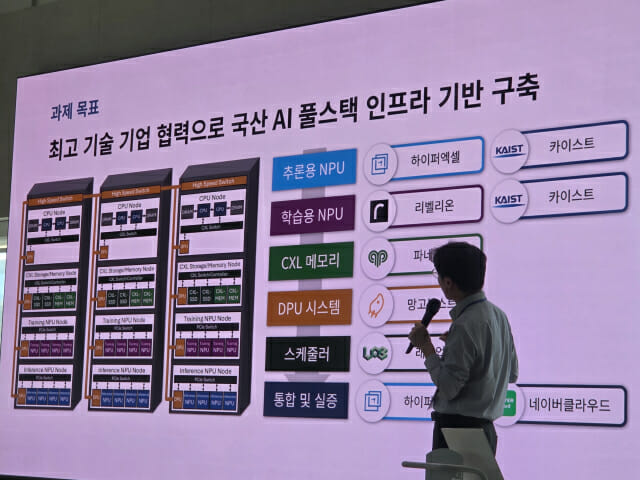
HyperAccel’s cluster roadmap pools processing, memory and CPU resources for software to allocate dynamically. The project runs from April 2025 through December 2030.
HyperAccel and Rebellions plan to test different NPUs and data-processing units together in one server during the project’s third year. HyperAccel also reported an initial proof of concept with Naver Cloud using Bertha.
The roadmap calls for single-node integration in years one through three, followed by multi-node integration in years four through six. Naver Cloud and SKT are named as demand-side partners for validation and commercialization.
Notable Developments
- InterX — Filed for a KOSDAQ IPO seeking KRW 30–39 billion. The manufacturing AI company reported a 41% revenue decline in 2025 and widening operating losses.
- RabbleUp — Outlined a KOSDAQ offering targeting KRW 41.4–48 billion for research, infrastructure and overseas expansion. It reports more than 120 deployment sites and 94.7% recurring revenue in 2025.
- FuriosaAI — Raised $620 million at a $2.9 billion post-money valuation. It plans to expand RNGD inference chip production and develop its next chip.
- Ailytics — Raised $7.4 million in Series A funding for industrial vision AI and overseas expansion. It reports deployments at more than 400 sites in 15 countries, alongside unverified safety improvement figures.
- Huixi Intelligence — Reported more than RMB 2.5 billion in equity funding during 2026 after completing Pre-B+ and Series B rounds. It plans to develop embodied AI chips and scale deliveries, but did not disclose individual round sizes.
- China Ministry of Commerce — Proposed export prohibitions or restrictions covering 23 AI-related technologies with the Ministry of Science and Technology. The measures remain proposals, and the report does not specify which technologies face each type of control.
- Ant Group — Released Ling-3.1-flash weights and reported that mixed-precision deployment reduced model-weight memory from about 534 GB to 292 GB. Its reported Hopper configuration uses four GPUs instead of eight; workload quality and latency still need evaluation.
- Iole — Signed a share-exchange agreement to make WOODMAN a wholly owned subsidiary, with the transaction scheduled for November 30. The combination supports a planned GPU cloud business, but available capacity and customer contracts were not disclosed.
- MiniMax — Released M3.1 Flash with input pricing of $0.15 per million tokens. It claims agent-task costs are 70% lower than its previous model and online inference is nearly three times faster.
- Sunrise — Showcased its S3 inference GPU and a 256-card supernode. It claims five times the inference performance and about 90% lower token costs than S2, without disclosing benchmark methodology.
By Country
🇰🇷 Korea
- Nation A — Nation A raised 8.5 billion won to integrate AI video tools and interactive storytelling, strengthen GPU infrastructure and expand overseas.
- TraceWeave — TraceWeave raised 3 billion won at a reported 30 billion won valuation to develop Phase-TITAN, its architecture for running AI agents locally on devices.
- VESSL AI — VESSL AI signed a GPU infrastructure financing MOU with Korea Investment & Securities; investment amounts and structures will be negotiated project by project.
- Desilo — Desilo secured up to 1.5 billion won in government research support over three years to develop an encrypted LLM inference engine.
- KT Token Factory — KT plans to launch Token Factory with 73 AI models through one API, expanding to more than 500 by year-end through OpenRouter.
- Maestro Forensics — Maestro Forensics launched Wisdom AI Agent, connecting digital evidence analysis and reporting to Claude Desktop and Codex through MCP.
- Nums AI — Nums AI's Causilo appeared in Jensen Huang's GTC Berlin keynote alongside Kumo-Tabular and TabPFN-3.5, according to Platum.
- KT Cloud — KT Cloud is starting an Ansan AI data center project with 50 MW of incoming power capacity, targeting completion in 2029.
🇨🇳 China
- Shangxuan Xinzhi — Shangxuan Xinzhi introduced MITA, an MRAM-based architecture for AI inference, and plans to tape out its first chip in March 2027.
- NCC — NCC raised more than RMB 1 billion in a C2 round led by Jian Tou Investment to develop inference chips and prepare for mass production.
- 超衍智能 — Apex Intelligence released Apex-35B-V1.0, a model built on Qwen for coding, agent tasks and scientific research, using its Apex Research system in development.
- Micro-Nano Core — Micro-Nano Core raised more than RMB 1 billion in C2 funding and plans customer testing of three inference chips in early 2027.
- Today AI — Today AI disclosed more than $200 million in cumulative funding from investors including Tencent and Ant Group for its personal assistant.
- Today AI — Today AI secured more than $200 million in financing for a personal assistant that draws memory from conversations and user-authorized services.
- iFlytek — iFlytek launched Spark X2.6 with a one-million-token context window and open-sourced Spark X2.6-4B for on-device use.
- Xingyi Intelligence — Xingyi Intelligence raised tens of millions of yuan across seed and seed-plus rounds to develop physical AI data tools and delivery infrastructure.
🇯🇵 Japan
- Privacos — Sunnies raised 50 million yen in seed funding and launched AI Workforce Control to manage employee and AI agent permissions on one platform.
- Sunnies — Sunnies raised 50 million yen in seed funding and launched Privaco controls for AI agent permissions, human approvals and activity logs.
- AMD — AMD and Intel agreed to combine their PyTorch CPU optimizations in the open-source oneDNN library, including AMD's ZenDNN work.
- NTT DATA — NTT DATA launched AI for Insurance, an AIVista-powered managed service that applies agents to underwriting, claims, policy servicing and compliance.
- DataSection — DataSection began operating GPU clusters and providing AI compute services for an unnamed US AI infrastructure provider under a September contract.
- イオレ — Eole joined Digital Dynamic's planned AI data center project, which targets 300 sites and 600 MW of incoming power capacity in Japan around 2030.
- Recursive — Recursive released Flint, a free laptop coding model, saying its human-supervised Eureka research system helped develop it in under four months.
- WingArc1st — WingArc1st launched DataTetra, a capacity-priced enterprise data platform that aims to reduce repeated AI calls by recording and reusing processing logic.
🇮🇳 India
- Simplismart — Simplismart secured $14 million in Series B funding led by Dallas Venture Capital, with NVIDIA participating, to expand its AI inference platform.
- Karta AI — Karta AI raised $3 million in seed funding to expand its multilingual voice agents for banks, lenders, fintech companies and insurers.
- E2E Networks — E2E Networks plans to add 5.4 MW of NVIDIA Blackwell GPU capacity in India, bringing its total AI infrastructure capacity to approximately 14.6 MW.
- Bharat1.AI — Bharat1.AI has opened one floor of its Bengaluru AI Superpark and seeks $650 million for a wider project that includes a planned 70-acre testbed.
- Google — Google expands AI programs in India with an agricultural API preview, an Amnex integration partnership and a $15 million Google.org initiative for small-business AI tools.
- Sarvam — Sarvam signed an agreement with India's integrated defence staff to build an AI framework covering the Army, Navy and Air Force.
Other East Asia
- HTC — HTC is positioning its $499 Vive Eagle glasses around privacy controls and login-free AI access, testing trust as a differentiator in consumer assistant distribution.
Southeast Asia
- Ready Server (SG) — Ready Server adds shared, OpenAI-compatible LLM inference to all VPS plans without token charges, using fair-share queues to manage demand.
Compiled from 35 linked sources across AI Market Watch's Asia news index. Fortnight covers 2026-10-16 – 2026-10-30.
