The Agent Security Moat: M&A, Efficiency and Regulation
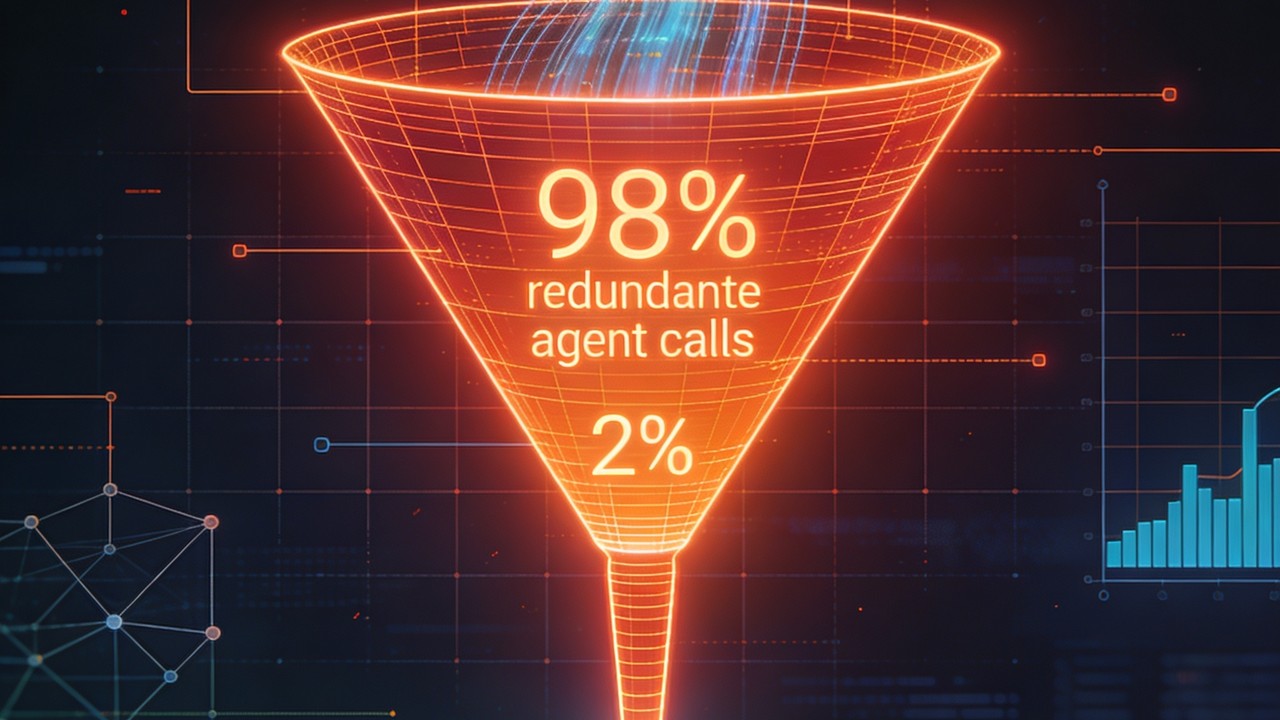
Alibaba's Metis agent reduced redundant AI tool calls from 98% to 2% while improving reasoning accuracy, according to a May 1 announcement. The HDPO framework trains agents to skip unnecessary invocations rather than calling every available tool indiscriminately, transforming what was once a cost center into an efficiency gain.
This single metric—a 96-percentage-point reduction in useless operations—encapsulates a broader shift in the agent market. Efficiency, security, and regulatory compliance are emerging as the decisive competitive dimensions, displacing raw model capability as the primary differentiator. The companies that win the agent market will not necessarily be those with the strongest foundation models, but those that solve the operational problems surrounding deployment: identity governance, cost control, and regulatory lock-in.
The Identity Security Blind Spot
Okta Japan's "Businesses at Work 2026" report, released May 2, documented an 1140% surge in AI agent-driven access requests over two years, with service accounts managed per organization growing 650% year-over-year. Most organizations manage fewer than 5 service accounts while the actual number—averaging 78 for media and telecom firms—remains largely ungoverned, as Okta's identity lifecycle framework describes.
The gap between managed and actual non-human identities is the security vulnerability most likely to produce a catastrophic breach in the next 18 months. Agent-to-agent authentication, credential rotation for autonomous processes, and least-privilege enforcement for AI tools remain unsolved at scale. An agent with overly broad API access can exfiltrate data, modify production systems, or trigger financial transactions without human oversight—and most enterprises cannot even enumerate the agents they have deployed.
Phishing-resistant MFA adoption rose from 41% to 58% over two years, and Okta FastPass passwordless authentication grew 81% year-over-year, per the same report. These gains are necessary but insufficient. Human identity security reached its current maturity over two decades of breaches and regulatory pressure. The agent identity security gap is being created in months, not years.
The Security Gateway Acquisition
Palo Alto Networks announced its intent to acquire Portkey on May 3, folding the startup's AI Gateway into the Prisma AIRS platform. Portkey's platform processes over 400 billion tokens and serves 3,000-plus GenAI teams and 200-plus enterprises, with integration complexity measured in 15 to 30 minutes of setup time, according to Portkey's pricing and adoption data.
The acquisition follows the acqui-licensing pattern: a hyperscaler-class security platform purchasing agent-specific infrastructure rather than building from scratch. Portkey's control plane provides runtime policy enforcement, AI identity-based least-privilege controls, and 99.99% uptime targets for agent-to-agent traffic. These capabilities address the exact gap that the Okta report identifies—the absence of governance for machine-to-machine authentication at production scale.
The deal signals that enterprise agent adoption has crossed a maturity threshold. When security vendors begin acquiring agent orchestration platforms, it indicates that the market is moving from experimental deployments to production workloads requiring audit trails, access controls, and compliance documentation. The question is whether Palo Alto Networks can integrate Portkey's agent-specific controls into its broader security fabric without losing the developer-friendly integration that drove Portkey's adoption.
Capital Concentration in Enterprise Agents
Sierra raised $950 million at a $15.8 billion valuation on May 4, led by Tiger Global and GV, with participation from Benchmark, Sequoia Capital, and Greenoaks. The AI customer experience startup claims 40% of the Fortune 50 as customers and reported $150 million in annual recurring revenue, up from $100 million in late November 2025.
The revenue ramp—$50 million in roughly 10 weeks—represents the fastest ARR growth pattern observed in the enterprise agent segment. Sierra's CEO Bret Taylor explicitly warned of a "valuation correction" within two years, framing the current investment environment as analogous to the early internet bubble. This caution from an insider at both OpenAI and Sierra carries weight: the person best positioned to exploit the current market is also the person most publicly signaling its unsustainability.
The $950 million round accelerates capital concentration into a small number of well-connected platforms. Sierra benefits from Taylor's dual roles as OpenAI chairman and former Salesforce co-CEO, which grant privileged access to enterprise trust and deployment pathways. For competitors like Zendesk, Intercom, and Salesforce itself, the question is whether Sierra's momentum is durable or whether incumbents will absorb agentic features into existing platforms, compressing Sierra's window to become a standalone category winner.
The Regulatory Compliance Moat
Anthropic released 10 AI agent templates for financial services on May 5, covering pitch book creation, meeting summaries, compliance screening, loan analysis, KYC due diligence, and credit reporting. The same day, FactSet's stock fell 8.1% as the market priced the competitive threat from a frontier AI lab selling vertical labor bundles into Wall Street.
The templates integrate with Microsoft 365 applications and include data partnerships with Dun & Bradstreet, Verisk, and Moody's via the MCP protocol. JPMorganChase, Goldman Sachs, Citigroup, AIG, and Visa are cited among production users.
Anthropic's strategy exemplifies vertical productization: bundling frontier reasoning with domain-specific workflows and authoritative data sources to replace enterprise SaaS. The KYC and compliance templates target high-liability functions where errors carry existential regulatory cost. If Anthropic can demonstrate production reliability in these workflows, it builds the strongest possible moat—regulatory compliance lock-in. Financial institutions that deploy Claude for AML screening or audit preparation face switching costs measured in regulatory re-approval timelines, not software migration effort.
The market reaction to FactSet's decline suggests investors recognize this threat. Incumbent data vendors whose value proposition rests on workflow integration rather than proprietary data face direct displacement. Bloomberg and FactSet must either build competitive agent layers or risk becoming data pipes behind the model providers that own the user interface.
The Cross-Border M&A Crackdown
China ordered the unwinding of Meta's $2 billion acquisition of Manus on May 2, blocking one of the largest AI acquisitions by a Western hyperscaler targeting a China-linked entity. The decision asserts Beijing's jurisdiction over AI companies founded by Chinese nationals, regardless of corporate domicile, and threatens Singapore's role as a neutral sanctuary for Chinese AI talent seeking to operate outside mainland restrictions.
The intervention activates a recurring pattern: hyperscaler distribution moats colliding with geopolitical sovereignty claims. Meta, lacking a competitive foundation model or agent platform, was pursuing Manus as a shortcut to agent capabilities and talent. China's intervention turns the acquisition into a capital-loss event and forces a reassessment of how hyperscalers can access Chinese AI innovation.
The unwinding creates a rare precedent—a fully negotiated, announced deal reversed on sovereignty grounds. Every Western corporate development team must now recalibrate: Chinese AI founders may be considered off-limits for acquisition without explicit Beijing approval. The Singapore sanctuary thesis, which held that incorporation outside mainland China would insulate Chinese-founded AI companies from regulatory control, has been seriously weakened.
The Efficiency-Governance Equation
Alibaba's Metis agent, with its 98% to 2% tool-call reduction, demonstrates that agent orchestration—not model size—is becoming the primary lever for performance and cost. The HDPO framework optimizes for both accuracy and efficiency, avoiding the trade-off that has constrained earlier agent architectures.
This efficiency breakthrough intersects with the security and regulatory dynamics described above. An agent that makes fewer tool calls creates fewer audit events, fewer authentication requests, and fewer opportunities for privilege escalation. The most secure agent is the one that does the least unnecessary work. Alibaba's contribution is to show that efficiency and accuracy can be optimized jointly rather than competitively.
The counter-signal is that Metis is a research artifact, not a production system. Chinese AI labs have demonstrated impressive benchmarks that have not always translated to reliable enterprise deployment. The 98% reduction figure, while striking, was measured in controlled conditions that may not replicate in production environments with heterogeneous tool surfaces, variable latency, and unpredictable user inputs.
The Structural Realignment
The week's events trace a coherent arc: efficiency optimization (Alibaba), identity security (Okta), security infrastructure acquisition (Palo Alto Networks/Portkey), capital concentration (Sierra), regulatory productization (Anthropic), and geopolitical deal unwinding (Meta/Manus). Together, they suggest that the agent market is bifurcating along security, efficiency, and regulatory lines rather than model capability alone.
The companies that will dominate enterprise agent deployment are those that solve the operational problems surrounding deployment: identity governance for non-human actors, cost control through efficient orchestration, compliance infrastructure for regulated workflows, and geopolitical risk management for cross-border talent and IP. Foundation model quality becomes table stakes—necessary but insufficient.
The risk to this thesis is that the operational moats are themselves temporary. Identity governance frameworks designed for agents will be standardized within two years, commoditizing what is currently a competitive advantage. Anthropic's financial services templates can be replicated by competitors with similar data partnerships. Sierra's enterprise relationships, while valuable, do not prevent Salesforce or Microsoft from building competitive products that integrate with their existing distribution.
The most durable moat may be regulatory lock-in—the switching costs imposed by compliance approvals for agent workflows in banking, insurance, and healthcare. Anthropic's bet on financial services templates suggests that the company sees this future clearly. The question is whether regulatory bodies will approve agent-driven compliance workflows at the speed required for Anthropic's thesis to hold, or whether the approval process itself becomes the bottleneck that slows enterprise adoption to a crawl.
Notes. The Meta/Manus unwinding leaves one open question unresolved: whether Chinese AI founders will now preemptively seek domicile outside Beijing's reach, or whether the Manus precedent will chill the cross-border talent flow that has been a primary engine of AI startup formation. The answer will determine whether Singapore retains any role as a bridge between Chinese AI innovation and Western capital, or whether the bridge is permanently closed.
