
The AI Agent Reckoning: From Adoption to Accountability
Enterprises are spending an average of $186 million annually on AI, yet only 8% have achieved meaningful business returns, according to a KPMG report cited by Botanu in its June 10 stealth launch (Botanu emerges from stealth, reveals enterprises spend $186M annually). That ratio—massive investment, vanishing proof—is the structural tension this market has spent two years ignoring. Botanu's bet is that the problem isn't underdeployment but undermeasurement: treat AI agents like hires whose output must be tracked, not software licenses to be amortized.
The company emerged with a platform that reads telemetry across model vendors, tools, and infrastructure layers to reconstruct an agent's full digital footprint and tie that spend to business outcomes in systems like CRM. Founder Alina Vrsaljko put the diagnosis precisely: "Companies aren't failing because AI doesn't work. They're failing because they can't locate where their agents are working." The framing updates the canonical lesson from AutoGPT's 2023 arc—where viral GitHub adoption collapsed against <30% task completion—into an enterprise context: adoption metrics (agent deployments, token consumption, seat counts) have weak predictive validity for production value.
Botanu is not alone in identifying this gap. Three other funding and product events this week each target a different dimension of the same underlying problem: the market is pivoting from piloting agents to governing them, and that pivot is creating new categories.
NewCore emerged from stealth on June 15 with $66 million from Cyberstarts, Index Ventures, and Evolution Equity Partners to build a security-first identity platform designed from the ground up for both human and AI agent identities (NewCore emerges from stealth with $66M). The founders—Zohar Alon (ex-Dome9, acquired by Check Point), Amihai Neiderman (ex-Nym Health, Unit 8200), and Erez Yarkoni (former CIO at T-Mobile and Telstra)—are targeting a structural gap: the dominant identity platforms (Okta, Microsoft Entra ID, Ping Identity) were architected for a world where only humans logged in. They were never designed to govern identities that spin up in seconds, operate autonomously, and require fine-grained, revocable access to production systems.
The platform introduces Secure Split Key technology to eliminate single points of compromise in SAML/OIDC infrastructure, VisualMFA for out-of-band authentication, and an Agentic Skill integration package that allows coding agents like Claude Code, Codex, and Cursor to operate as first-class identities with their own lifecycles and revocation paths. This last feature is the most strategically telling: by shipping an off-the-shelf agentic identity package for the most widely-used coding agents, NewCore is positioning itself as the defaults layer for how enterprises let AI agents touch production infrastructure.
The pattern mirrors the earlier cloud-era security startup arc. Zscaler and CrowdStrike built zero-trust architectures from scratch rather than retrofitting perimeter defenses, and scaled because the incumbents' architectural assumptions were incompatible with the new workload model. The same structural incompatibility now applies to identity: Okta cannot retrofit agent lifecycle management onto a human-centric identity graph any more than FireEye could retrofit cloud workload protection onto a network-security appliance. The $66 million round is substantial at Series A/B stage but not transformative—it buys time to land early design-in customers and build the reference architecture. The open question is whether NewCore becomes a standalone category or an acquisition target for Okta or Microsoft once the incumbents acknowledge the architectural debt.
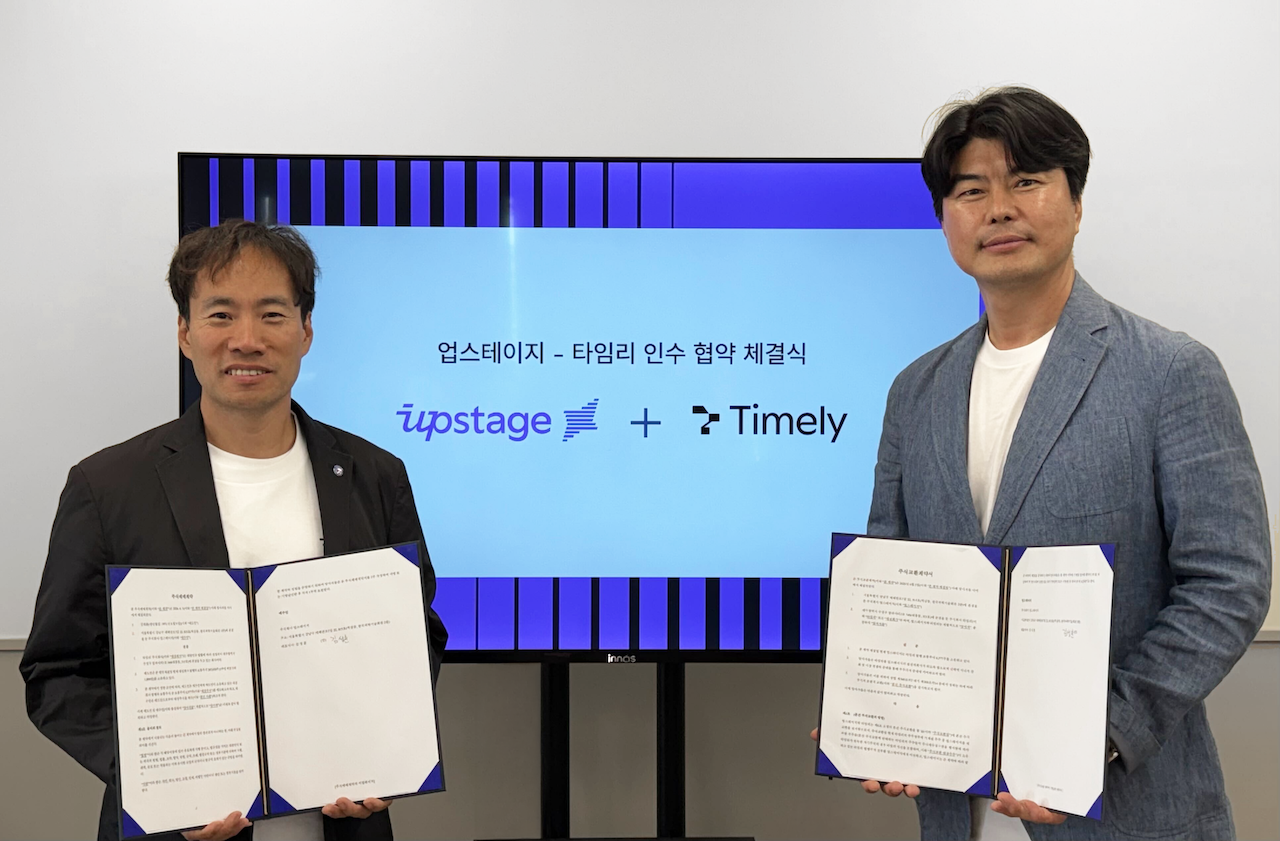
Upstage, the Korean AI company behind the Solar foundation model, acquired Timely, a no-code AI agent platform startup, to expand beyond enterprise customers into consumer and public sector markets (Upstage acquires Timely). Timely's platform is already deployed in public institutions, including Seoul's municipal AI chatbot service, and across local governments and educational organizations nationwide. This acquisition follows Upstage's earlier purchase of portal operator AXZ (operator of Daum). The company now owns a foundation model (Solar), a consumer portal (Daum), and a no-code agent platform (Timely) deployed in public sector infrastructure.
The move validates a pattern that is also visible elsewhere: mid-tier foundation model labs are acquiring downstream platforms to bypass the hyperscaler distribution bottleneck and capture end-user value directly. Rather than competing with OpenAI and Anthropic on model capability—a race they are structurally disadvantaged to win—Upstage is betting that owning the agent platform and the user interface creates a defensible position. By integrating Solar LLM into Timely's already-deployed public sector infrastructure, Upstage can immediately reach millions of users without the customer acquisition cost typical of B2C AI products. The question is whether Timely's public sector DNA translates to the broader consumer market, or whether Upstage needs a third consumer-native piece to complete the puzzle.

The Moveworks precedent, which involved enterprise distribution and trust assets compounded when LLMs arrived, is instructive here. Moveworks, before its acquisition, was a pre-LLM AI company that compounded enterprise distribution and trust assets when LLMs arrived. Upstage appears to be attempting a variant: acquire distribution (Daum's portal traffic) and an agent platform (Timely's public sector deployments), then layer the model on top. The difference is that Upstage owns the model layer rather than integrating third-party models, which gives it a margin structure Moveworks never had—but also means it bears the full cost of model improvement, which Moveworks never had to.
Alibaba Cloud's Tongyi Qianwen released a free AI college application assistant agent on June 10 for China's 12.9 million Gaokao examinees, fine-tuned from the Qwen family and integrating eight years of data from Alibaba's Quark education service covering nearly 3,000 universities and 2,000+ majors (Alibaba Cloud launches free Gaokao AI agent). The agent provides a calendar for tracking post-exam tasks, a personalized college and major selection report, and an interactive Q&A system with structured refusal of unconfirmed information—the agent will not answer questions about provincial cutoffs until official data is released. Alibaba claims it underwent 400,000 simulated student profiles for stress-testing and is optimized for rural and older users on weak networks.
This launch exemplifies the hyperscaler distribution moat that Chinese cloud giants are building by embedding AI agents directly into high-stakes consumer life events. Alibaba is not selling the agent—it is providing it free as a quasi-public service, consistent with the pattern of AI capital being deployed to capture user trust and data at scale rather than monetize upfront. The agent's 49 specialized retrieval tools, independent memory engine, and explicit "know what it does not know" guardrails are a deliberate architecture for building user trust in a domain where a single mistake can derail a life. The approach directly addresses the AI hallucination risk that has historically blocked trust in high-stakes decision-making agents, and the data moat—eight years of proprietary admissions data from Quark—is defensible in a way that general-purpose agent capability is not.
For the broader market, this moves the debate from "Can agents handle complex workflows?" to "Which hyperscaler can own the most trust-intensive consumer vertical first?"—a question that, in China, Alibaba, ByteDance, Tencent, and Baidu will race to answer aggressively. Expect a wave of similar free, high-stakes agent rollouts in finance (tax filing), healthcare (diagnosis triage), and legal (contract review) within the next 12 months.
Taken together, these four events tell a coherent story. Botanu and NewCore are building the measurement and security infrastructure that enterprise agents need to move from pilot to production with CFO and CISO approval. Upstage is demonstrating that distribution—not just model capability—is the binding constraint for mid-tier foundation model labs. Alibaba is showing that data moats and trust guardrails, not raw model intelligence, determine whether consumers will trust agents with life-altering decisions. Each is a response to the same underlying reality: the market has passed through the adoption phase and is now entering the accountability phase.
The risk is that these categories remain too narrow to support standalone companies. Botanu's ROI measurement platform depends on enterprises adopting sufficient agent telemetry standards for its cross-vendor approach to work—a coordination problem that no startup can solve alone. NewCore's identity platform requires enterprises to run it alongside or instead of Okta and Microsoft Entra ID, an upgrade that CIOs may defer until a high-profile agent security incident forces their hand. Upstage's consumer expansion assumes Timely's public sector DNA generalizes, which is not guaranteed. Alibaba's free Gaokao agent generates user trust but not near-term revenue, and the monetization path depends on upselling premium services in a market where Tencent and ByteDance can match the offer.

Notes. No single event this week alone reshapes the agent market. The signal is cumulative: measurement, security, distribution, and trust are each emerging as binding constraints that the pure "deploy agents faster" narrative has not addressed. The companies that solve these constraints will define the next phase of enterprise AI adoption. The companies that ignore them will be acquired for their user bases, not their agent capabilities.
