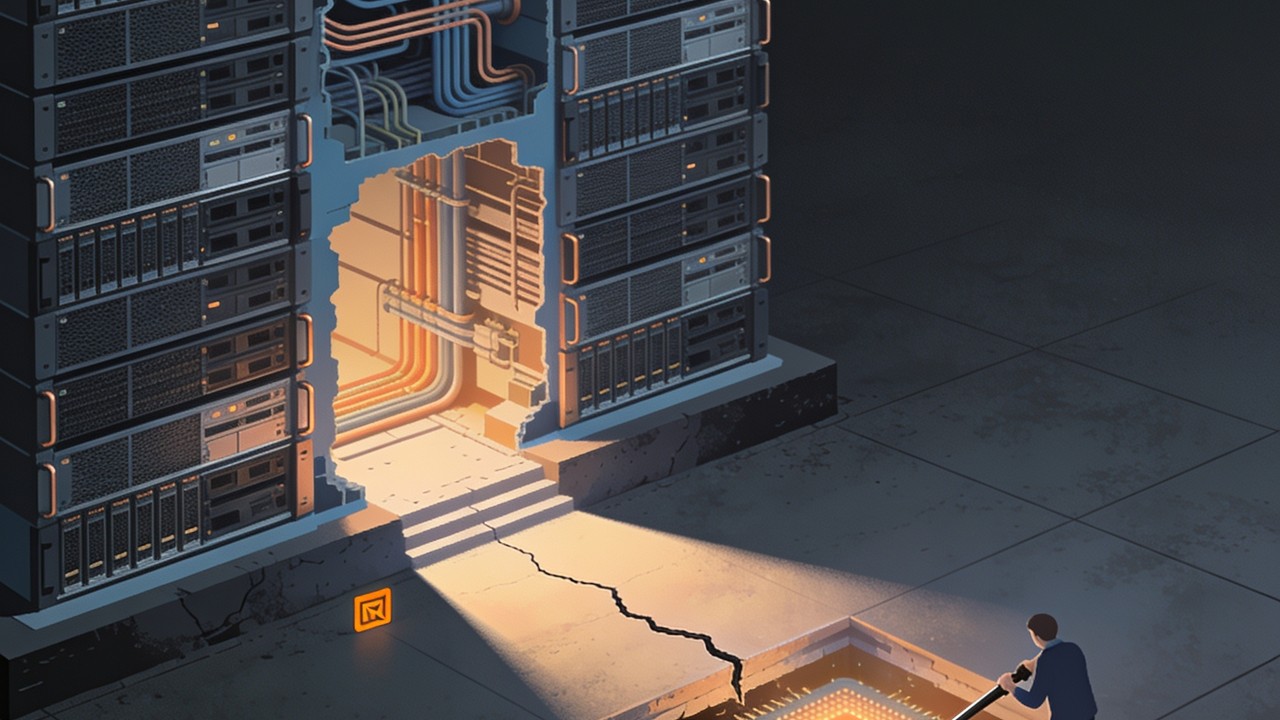
Alibaba supplied Moonshot AI with roughly 20,000 Nvidia chips through a cloud computing agreement, and the model those chips trained — Kimi K3, a 2.8-trillion-parameter open-weight release — now outperforms Alibaba's own Qwen models on several benchmarks. Kimi K3 placed fourth on the Artificial Analysis Intelligence Index and beat Claude Opus 4.8 and GPT-5.5 on coding tasks.
The tempting read is that Alibaba made a bad bet on a portfolio company. The more useful read is that the frontier weight class no longer requires owning a datacenter. It requires renting one for long enough, and then giving the weights away.
The landlord owns the building, not the tenant's business
Alibaba occupies two roles here simultaneously: investor in Moonshot and cloud supplier to Moonshot. Neither role confers ownership of the output. A cloud agreement transfers compute hours; it does not transfer the post-training recipe, the kernel work, or the resulting weights. Moonshot's kernel optimizations ran on Nvidia H200 hardware, a chip conditionally available to approved Chinese firms — meaning the differentiated asset was the optimization work, not privileged silicon access.
This is the inversion that matters for anyone modeling hyperscaler moats. That thesis assumes compute is possessed. When compute is leased, the compounding accrues to whoever runs the better experiment on it, and the landlord captures only the rent. Alibaba financed a competitor's flagship and collected cloud revenue for the privilege.
The structure isn't new — hyperscalers have bundled equity and credits into frontier labs for years, and the arrangement generally worked because the investee stayed downstream of the investor's own model roadmap. What broke this time is that the tenant shipped a better model than the landlord's internal lab, on the landlord's machines, and then open-sourced it.
Export controls police the truck, not the terminal
There is a regulatory dimension that the Bloomberg reporting surfaces and that most coverage underplays. US chip export controls govern the physical transfer of hardware across borders. They do not govern remote access to that hardware via a cloud API. The physical location of the cluster that trained Kimi K3 remains unconfirmed, which is precisely the point: a control regime built around customs manifests has no clean handle on a login.
That gap is not an oversight so much as a structural mismatch. Restricting chip shipments assumes the constrained resource is the chip. If a domestic cloud provider can aggregate conditionally-available hardware and lease it by the hour, the constraint moves from who owns accelerators to who can afford the invoice — a much lower bar, and one that venture capital clears easily. You do not need to own the compute. You need six months of it.
Two countries proved it in the same week
If Kimi K3 were the only data point, it would be a story about one unusually good Chinese lab. It isn't.
SK Telecom open-sourced A.X K2, a 688-billion-parameter MoE model, on Hugging Face under Apache 2.0 — the largest open-weight model yet released from South Korea, with 256 experts (8 active, 33B activated), a 256K-token context window, and 8.2 trillion pretraining tokens. SKT claims it matches or exceeds Qwen 3.5-397B-A17B, DeepSeek-V4 Flash, and GLM-5.1 on selected benchmarks, particularly in math, Korean-language reasoning, and long-document understanding.
Days later, LG AI Research released K-EXAONE 2.0 at 750 billion parameters, also Apache 2.0, also on Hugging Face, scoring 70.1 average across 24 benchmarks — a 10% improvement over its 236B predecessor — with 94.4 on OpenAI-MRCR, 89.6 on Ko-LongBench, and 14.2 on Tau3-Bench Banking. Both models emerged from South Korea's Ministry of Science and ICT sovereign foundation model project.
Two 680B-plus open-weight models from a single country inside one week is not a coincidence of scheduling. It is what happens when the barrier to the frontier weight class stops being access to accelerators and starts being a national budget line and a rental agreement. The open-weight distribution moat that Mistral and Meta built by giving weights away is now the default entry strategy for state-backed and telco-led labs, because it is the only strategy that buys ecosystem position without a decade of consumer distribution.
The gap that remains is real and worth naming precisely. A.X K2's 688B total (33B active) trails the trillion-parameter tier set by Kimi K3 at 2.8T and Qwen 3.8 at 2.3T, and its 256K context window sits below the 1M-token threshold now standard at the frontier. Korea has entered the weight class. It has not yet entered the top of it.
Alibaba then opened its own remaining model
On August 3, Alibaba released Qwen3.8-Max, a 2.4-trillion-parameter open-weight model, claiming it trails only Claude Fable 5 and some Opus models on the Arena leaderboard while beating nearly all comers in coding and visual analysis. The weights ship next week, reversing a brief pivot toward proprietary models.
Read against the Kimi K3 story, this is the more consequential of the two events. Alibaba's response to being outrun by its own tenant was not to close the model and defend margin. It was to open a 2.4T model and compete on distribution. That is a company concluding that keeping Qwen closed against a 2.8T open competitor is not worth defending — that the ecosystem position is the asset and the API rent is not.
Hugging Face CEO Clement Delangue has argued publicly that China's open-source strategy could make it the next AI superpower, and his vantage point — operating the repository where these releases land — gives that claim more weight than the usual geopolitical commentary. But the mechanism he describes is commercial before it is geopolitical. Open weights are how a lab without consumer distribution buys developer default status, and they are also how a lab with distribution prevents a challenger from buying it.
The price cut is a symptom, not a strategy
OpenAI cut GPT-5.6 Luna prices by 80% amid intensifying competition from Google and Anthropic.
The standard framing calls this a price war — labs with the deepest capital reserves compressing margins to squeeze out weaker competitors, with concentration as the eventual outcome. That framing describes a fight among closed API providers.
An 80% cut is what you do when the alternative to your API is not a competitor's API but a free download. When a 2.8T model and a 2.4T model are both open-weight and a 750B model is Apache-2.0 licensed, the ceiling on inference pricing is set by the cost of self-hosting plus the operational overhead of doing so, not by what the next-best closed lab charges. Every open-weight release at the frontier weight class lowers that ceiling mechanically. The price cut is downstream of the assembly mechanism described above, not a discretionary competitive gesture.
This has a specific implication for the concentration thesis. If margin compression were driven purely by capital-rich labs outspending each other, then survival would correlate with balance sheet, and the field would narrow. If it is driven by open weights setting a substitution floor, then no amount of capital restores the margin — you cannot outspend free.
The retreat, and what it prices
01.AI, once counted among China's Big Six foundation-model startups, has formally abandoned large-scale base-model pretraining for enterprise AI solutions, filing for a 2027 Hong Kong IPO with total contract orders exceeding RMB 15 billion ($2.1 billion) as of May 2026. It reported audited 2025 revenue of roughly RMB 2.5 billion ($350 million) against annual operating costs of RMB 200 million (~$28 million) after halting pretraining.
The economics are the argument. Kai-Fu Lee's lab concluded that orchestrating open weights from DeepSeek, Tongyi Qianwen, and Zhipu produces better returns than training base models, and the cost line — roughly $28 million a year — quantifies exactly how much of a foundation-model company's expense was pretraining. Nearly all of it.
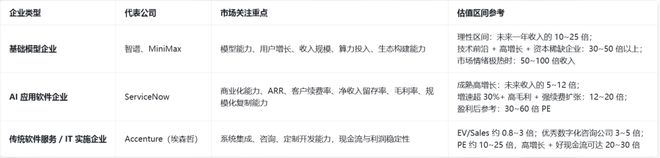
Here is the counter-signal, and it is the strongest one in this week's reporting. Huang Lichong of Huisheng International Capital cautioned that "orders are not revenue, revenue is not profit, and profit is not cash." A $2.1 billion order book at a company running $28 million in annual costs describes either a platform business whose costs do not scale with its order book or a project-delivery consultancy that has front-loaded its pipeline. The distinction determines whether 01.AI prices at a SaaS-like 12–20x forward revenue or a consulting-like 0.8–3x EV/Sales — a spread of roughly an order of magnitude on the same order book. If the orchestration model turns out to be headcount-gated services rather than repeatable software, the retreat from pretraining looks less like a shrewd capital-cycle read and more like an exit dressed as a pivot.
That risk cuts against the clean version of this column's thesis. Assembling frontier capability from rented compute and borrowed weights lowers the cost of building. It says nothing about whether the resulting business has margin structure. Moonshot proved you can reach the frontier weight class on someone else's machines. Nobody has yet proved what that position is worth once the weights are public and the API price has fallen 80%.
What the suppliers now have to reprice
For cloud providers, the Kimi K3 arrangement establishes a precedent that has to be priced into every future compute agreement: the customer renting your accelerators may ship a model that beats your internal lab's, using your hardware, and then release the weights for free. Compute contracts historically treated the tenant as a revenue line. They now also carry a competitive-displacement risk that no standard cloud agreement prices.
For policymakers, the gap is more awkward. A control regime that restricts hardware transfer while leaving remote compute rental untouched does not slow the thing it was designed to slow — it relocates it, from a shipping manifest to a billing relationship, where enforcement visibility is far worse.
Notes. The physical location of the cluster that trained Kimi K3 remains unconfirmed in this week's reporting, which leaves the central compliance question — whether any control was actually circumvented or merely rendered irrelevant — unresolved. That distinction determines whether this is a policy failure or a policy category error, and the available sourcing does not settle it.
