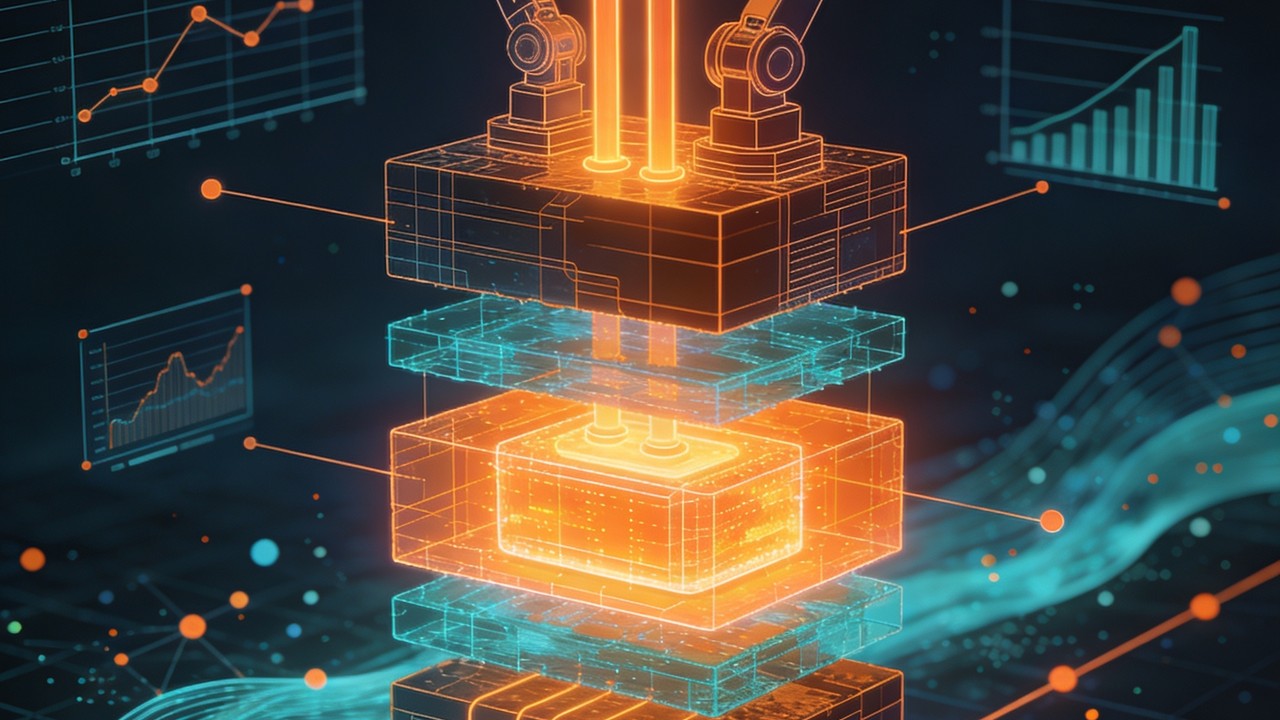
The Physical AI Infrastructure Stack Emerges
LimX Dynamics open-sourced its FluxVLA Engine on April 16, 2026, releasing a standardized engineering base for building and deploying vision-language-action models on physical robots. The platform unifies data processing, model training, simulation, and hardware deployment into a single configuration-driven pipeline, supporting models like Qwen, GR00T, and the Pi series across simulators including Isaac Sim and LIBERO.
The significance lies not in any single technical breakthrough but in the category of intervention FluxVLA represents. The company is not selling robots or licensing a model; it is distributing the middleware layer that makes VLA development reproducible across teams, hardware platforms, and use cases. This is the physical AI equivalent of what PyTorch did for deep learning research: standardizing the engineering interface so that researchers can focus on algorithmic advances rather than reinventing the integration pipeline each time.
That same week, Physical Intelligence released π0.7, a 5B-parameter VLA model built on a Gemma3 visual backbone, claiming demonstrations of compositional generalization—the ability to combine previously learned skills to operate an unseen air fryer or transfer grasping strategies between different robotic arm models without task-specific training. The company described this as a "GPT-3 moment" for robotics.
Whether that label holds is secondary to what the two announcements jointly reveal: the physical AI field is entering a phase where the bottleneck has shifted from model architecture to systems integration. π0.7's technical advance—a multi-layered prompting methodology that labels training data with quality and context metadata, enabling effective learning from diverse, unfiltered sources including failed attempts and human videos—is essentially a data-engineering insight dressed as a model improvement. FluxVLA's contribution is explicitly infrastructural: modular decoupling of visual encoders, language models, and action heads, with optimizations for 5-10x faster inference and real-time control smoothing.
Itstar (它石智航) completed a $455 million Pre-A round on April 17, led by Hillhouse Capital and Sequoia China with participation from Meituan and multiple government-backed funds. The company plans to invest the capital primarily in pre-training compute for its "AI World Engine" (AWE 3.0) and global talent acquisition. AgiBot, at its APC 2026 partner conference, announced it is entering what it calls the "deployment era," launching four new robot models, six AI models, and seven productivity solutions already deployed at leading enterprise production lines. The company disclosed 2025 revenue exceeding one billion yuan and committed over 2 billion yuan over five years to ecosystem development, including a global physical AI data network called "Hive" and a robot leasing platform.
Project Prometheus, co-founded by Jeff Bezos, is finalizing a $10 billion round at a $38 billion valuation, per 36Kr's April 22 report. JPMorgan and BlackRock are among the participating institutions. The company is establishing a separate investment holding vehicle to deploy billions into manufacturing firms, targeting aerospace, automotive, semiconductor fabrication, and defense contracting—purchasing distressed or inefficient legacy manufacturers at a discount and retrofitting them with Prometheus's physical AI technology.
Manycore Tech (群核科技) listed on the Hong Kong Stock Exchange on April 17, raising HK$1.224 billion after a HK$0.762-per-share IPO that attracted 1,591x oversubscription for its Hong Kong public tranche. The stock opened at HK$20.70, a 171% premium over the offer price, yielding a market capitalization near HK$35 billion. The company reported 2025 revenue of 820 million yuan with 82.2% gross margins and positive adjusted net profit of 57.1 million yuan.
Manycore's listing narrative centers on "spatial intelligence"—the company positions its core technology as the infrastructure layer for AI systems to understand, reconstruct, and interact with physical three-dimensional space. Its product portfolio, including the Coohome design platform, SpatialLM language model, and SpatialGen generation model, has accumulated over 500 million 3D scene data assets. The company has established partnerships with AgiBot, PICO, and Hesai Technology. Its revenue mix shifted from 90% interior design software in 2023 to include industrial digital twin pilots and embodied AI data licensing in 2025.
Taken together, these five events describe a market structure where robot hardware competition represented the dominant dynamic in 2024, while infrastructure platform competition represents the dominant dynamic as of April 2026. The capital concentration is extraordinary: Project Prometheus alone, at $38 billion, exceeds the combined valuation of every venture-backed humanoid robot company in the world, per 36Kr's April 22 report. Itstar's $455 million Pre-A round—for a company with no disclosed product revenue—is larger than many Series C rounds in the broader AI sector. Manycore's 1,591x IPO oversubscription indicates public market demand for exposure to the physical AI thesis that far exceeds the available supply of pure-play investment vehicles.
The mechanism driving this capital allocation is straightforward and has a clear precedent. In the same way that cloud infrastructure providers captured the majority of value in the software AI boom—AWS, Azure, and GCP collectively earn higher margins than any single application-layer AI company—the physical AI stack appears to be concentrating value at the infrastructure layer rather than the robot OEM layer. Unitree's G1 humanoid, launched at $16,000 in August 2024, demonstrated that hardware margins in humanoid robotics will compress rapidly once Chinese supply chains enter volume production. Unitree's planned Q2 2026 HKEX IPO, following a Series C reported at $1.7 billion in June 2025, will provide the first transparent financial disclosure for a pure-play humanoid manufacturer—but the G1's pricing already indicates that hardware gross margins are below 20% at volume, while infrastructure software margins exceed 70%.
Project Prometheus's strategy makes the infrastructure thesis explicit. Rather than licensing AI models to existing manufacturers at software margins, Bezos is building a $100 billion "manufacturing transformation vehicle" fund to acquire industrial companies outright, own the physical assets, and deploy AI as an operational upgrade within captive production environments, per ERP Today's report. This is not an AI company selling into manufacturing; it is an AI company becoming a manufacturer, using capital to solve the data-scarcity problem that limits physical AI training by generating proprietary industrial datasets that competitors cannot replicate.
The parallel with Amazon's own history is instructive. Amazon Web Services was not the first cloud provider, but it became the infrastructure standard by building the middleware layer—EC2, S3, Lambda—that abstracted away server management for developers. Project Prometheus is attempting the same play for physical industry: acquire the factories, build the simulation-to-reality pipeline, and sell the resulting capability as a service to companies that cannot afford to replicate the infrastructure independently.
Risks remain substantial. FluxVLA's adoption metrics are not yet visible; the LimX Dynamics GitHub repository shows 91 contributions over the past year with no activity in the current period, and FluxVLA as a standalone repository has no disclosed star count or contributor metrics. The success of an open-source infrastructure play depends entirely on community adoption, and there is no evidence yet that FluxVLA has achieved the network effects that made ROS or PyTorch indispensable.
The sim-to-real gap, which FluxVLA explicitly targets, remains the hardest unsolved problem in physical AI. π0.7's demonstrations, however impressive in controlled settings, have not been independently validated at commercial reliability levels. Physical Intelligence's claim of a "GPT-3 moment" is aspirational in precisely the dimension that matters: GPT-3's impact came from immediate, widespread developer access via API, whereas π0.7's capabilities remain confined to research environments with controlled conditions and expert supervision.
Manycore's spatial intelligence play faces a different challenge. The company's SpatialLM models achieve state-of-the-art results on benchmarks like Structured3D and ScanNet, but no direct benchmark comparisons exist against NVIDIA Cosmos or World Labs models. The risk is that Manycore's spatial infrastructure thesis is validated in design software—its historical core—but fails to extend into the higher-value industrial simulation and embodied AI training markets where NVIDIA and deep-pocketed startups like World Labs are also competing.
The pattern that emerges across all five stories is the same. Capital is flowing not to the company with the best robot, but to the company that controls the data pipeline, the simulation substrate, or the middleware integration layer. AgiBot's commitment of 2 billion yuan to ecosystem development—including a data network and leasing platform—is an infrastructure play. Itstar's entire thesis is the "AI World Engine" as a foundation model for physical reasoning. Manycore's IPO narrative is spatial intelligence infrastructure. Project Prometheus is acquiring factories to generate data.
The implication for analysts is uncomfortable for anyone tracking humanoid robot companies as the primary unit of analysis. The robot OEM may become a commodity provider, competing on unit economics against Chinese supply chains that can deliver a 127cm humanoid for $16,000. The value capture in physical AI will likely accrue to the companies that own the training data, the simulation environments, the standardized middleware, and the operational control of physical production assets—not to the companies that assemble the hardware.
Notes. The open question that this week's developments do not resolve is whether any single infrastructure provider can achieve the platform lock-in characteristic of software AI (e.g., NVIDIA CUDA, AWS) in physical AI, or whether the fragmentation of physical environments and industrial processes will prevent network effects from forming at the infrastructure layer. Manycore's 1,591x IPO oversubscription suggests investors are betting on the former. The next twelve months of deployment data will provide the first test.
