Understanding the AI Market Watch VC Score: A Complete Guide
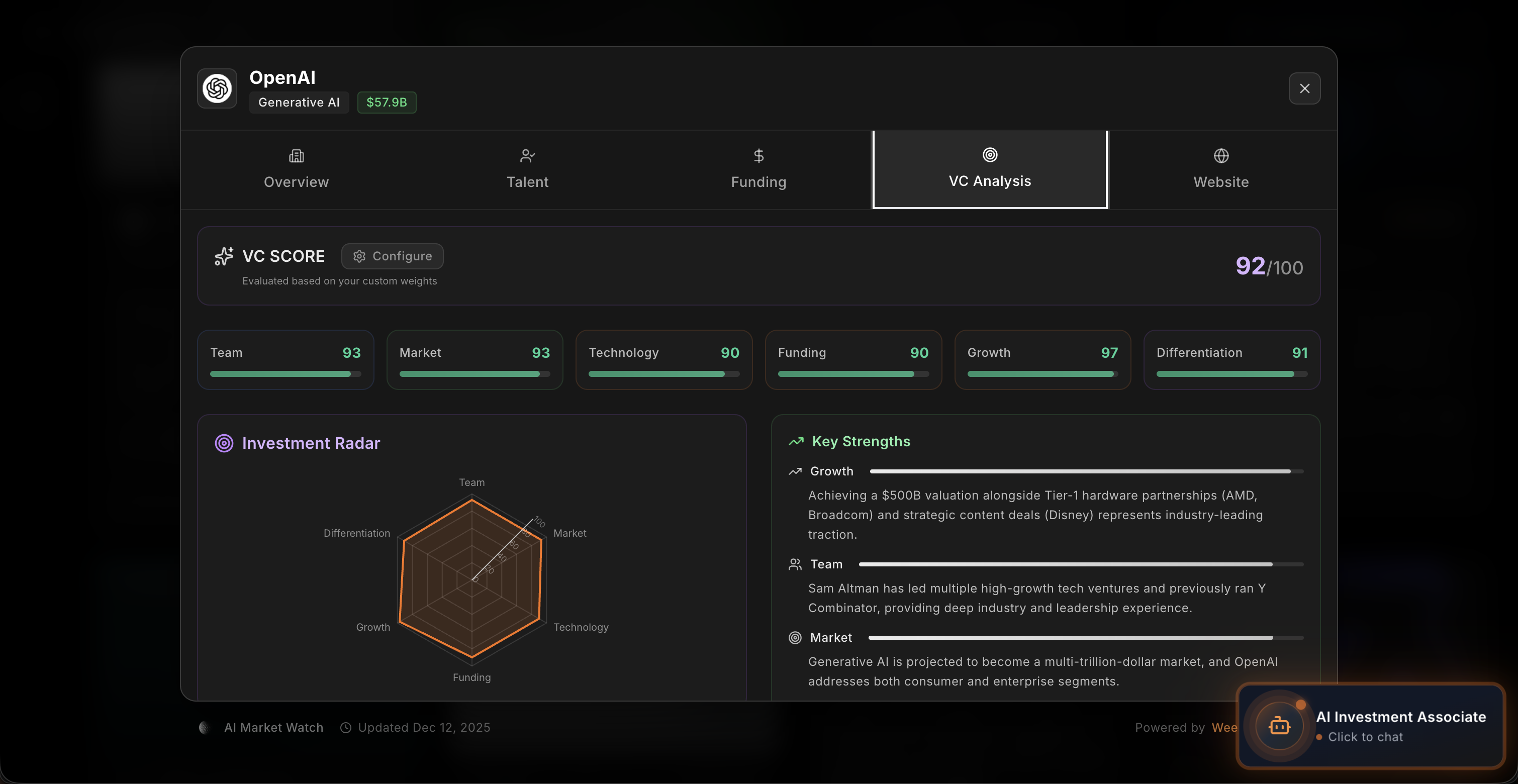
The VC Score is the cornerstone of our startup evaluation methodology—a sophisticated framework that mirrors how top-tier venture capitalists assess investment opportunities. This guide explains what the score represents, how it's calculated, and how to use it effectively in your research.
What is the VC Score?
The VC Score is a composite metric (0-100) that evaluates AI startups across six fundamental dimensions that experienced investors use to assess investment potential. Unlike simple rating systems, our methodology applies stage-adjusted criteria—recognizing that what makes an excellent early-stage startup differs significantly from what defines a strong late-stage company.
Core Philosophy: A well-performing Seed startup can score just as highly as a successful Series D company. Each is evaluated against stage-appropriate benchmarks, not absolute thresholds.
The Six Core Dimensions
Our framework evaluates startups across six interconnected dimensions, each capturing a critical aspect of investment attractiveness.
1. Team
The team dimension assesses the human capital behind the venture—often the most predictive factor of success, especially at earlier stages.
Key Evaluation Areas:
- Founder Background: Depth of relevant experience and domain expertise
- Track Record: Previous entrepreneurial or leadership achievements
- Team Composition: Complementary skills across technical and business functions
- Execution Capability: Evidence of operational velocity and milestone achievement
Why It Matters: VCs frequently cite "team" as their primary investment criterion. A strong founding team can pivot through challenges, attract talent, and execute against ambitious goals.
2. Market
The market dimension evaluates the opportunity landscape—whether the startup is pursuing a market worth winning.
Key Evaluation Areas:
- Market Size: Total addressable market and realistic serviceable segments
- Market Timing: Whether conditions favor adoption (technology readiness, customer awareness)
- Customer Validation: Evidence of genuine demand and willingness to pay
- Competitive Dynamics: Nature of competition and barriers to entry
Why It Matters: Even exceptional teams struggle in small or declining markets. Great timing with emerging technology trends can provide significant tailwinds.
3. Technology
The technology dimension examines the technical foundation—particularly important for AI companies where innovation is the core differentiator.
Key Evaluation Areas:
- Technical Innovation: Novel approaches, proprietary methods, or breakthrough capabilities
- Defensibility: Patents, trade secrets, or technical complexity that creates barriers
- Product Maturity: Development stage relative to company phase
- Scalability: Architecture and infrastructure readiness for growth
Why It Matters: For AI startups, technology isn't just a feature—it's often the entire value proposition. Strong technical foundations enable sustainable competitive advantage.
4. Funding
The funding dimension assesses financial positioning and investor confidence.
Key Evaluation Areas:
- Capital Efficiency: How effectively funding translates to business progress
- Investor Quality: Reputation and value-add of existing investors
- Funding Momentum: Recent activity and trajectory of investment interest
- Runway Health: Financial sustainability and path to next milestone
Why It Matters: Quality investors provide more than capital—they offer networks, expertise, and credibility. Strong funding signals external validation of the opportunity.
5. Growth
The growth dimension captures business traction and operational momentum.
Key Evaluation Areas:
- Customer Quality: Profile and diversity of customer base
- Traction Signals: Meaningful milestones and partnership achievements
- Business Model Strength: Clarity and sustainability of monetization approach
- Milestone Progress: Execution against stated goals and timelines
Why It Matters: At later stages, demonstrated traction becomes the primary evidence of product-market fit and execution capability.
6. Differentiation
The differentiation dimension evaluates competitive positioning and defensible advantages.
Key Evaluation Areas:
- Unique Value Proposition: Clarity of "why us" story
- Competitive Moat: Sustainable advantages (network effects, data assets, brand)
- Market Positioning: Strategic clarity in competitive landscape
- Brand Strength: Market recognition and customer trust
Why It Matters: In competitive AI markets, sustainable differentiation determines long-term value capture.
Special Focus: AI Capability
Given our focus on AI startups, we apply additional scrutiny to technology-specific factors that determine an AI company's competitive position. This includes evaluation of data assets, algorithmic innovation, AI talent depth, and infrastructure efficiency.
This specialized lens helps distinguish between companies that are merely "AI-enabled" versus those with genuine technical moats and innovation potential.
Stage-Adjusted Methodology
The Three Stages
Our methodology classifies companies into three developmental stages, each with distinct evaluation criteria:
EARLY Stage (Pre-seed to Series A)
- Emphasis on team quality, technical innovation, and market opportunity
- Growth metrics weighted less heavily—potential matters more than proof
- Focus on founder capability and vision execution
GROWTH Stage (Series B to Series C)
- Balanced evaluation across all dimensions
- Increased weight on customer validation and traction signals
- Execution track record becomes more critical
LATE Stage (Series D and beyond)
- Heavy emphasis on financial metrics and market position
- Competitive moat and differentiation carry significant weight
- Operational efficiency and path to profitability matter
Why Stage-Adjustment Matters
Without stage-adjustment, early companies would unfairly score low on metrics they haven't had time to develop. A seed-stage startup with exceptional founders and initial customer pilots might appear inferior to a mediocre late-stage company with revenue simply because revenue exists.
Our methodology corrects for this bias—evaluating each company against reasonable expectations for its phase.
Understanding Your Results
The Score Scale
| Score | Grade | Interpretation |
|---|---|---|
| 90-100 | A+ | Exceptional across nearly all dimensions |
| 80-89 | A | Outstanding performance with minor gaps |
| 70-79 | B+ | Strong showing with clear strengths |
| 60-69 | B | Solid fundamentals, some areas for improvement |
| 50-59 | C+ | Average performance with notable concerns |
| 40-49 | C | Below expectations in multiple areas |
| 30-39 | D | Significant issues requiring attention |
| Below 30 | F | Major concerns across most dimensions |
Reading Dimension Breakdowns
Beyond the aggregate score, examine the dimensional breakdown:
- Identify strengths: Which dimensions score highest? These reveal competitive advantages.
- Spot concerns: Lower-scoring dimensions may indicate risks or improvement opportunities.
- Consider balance: Highly uneven scores might indicate execution challenges.
Risk Factor Identification
Our evaluation also identifies potential concerns across three severity levels:
- Critical Concerns: Issues that could fundamentally threaten business viability
- Moderate Concerns: Challenges that may impact growth trajectory
- Watch Items: Factors worth monitoring as the company evolves
These risk factors provide important context that aggregate scores alone cannot capture.
How to Use VC Scores Effectively
Best Practices
Use for screening, not decisions: Scores help identify promising opportunities and flag concerns—they don't replace due diligence.
Compare within cohorts: Compare scores among companies at similar stages and in related categories—cross-category comparisons can be misleading.
Examine the breakdown: Don't just look at aggregate scores. Understanding why a company scored as it did reveals more than the number alone.
Track over time: A company's score trajectory can indicate whether momentum is building or concerns are emerging.
Combine with qualitative research: Scores quantify public information but cannot capture every relevant factor—recent news, insider dynamics, or strategic pivots may not yet be reflected.
Common Pitfalls to Avoid
- Over-indexing on aggregate score: Two companies with score 65 might have very different risk profiles
- Ignoring stage context: A 60 for a seed company means something different than a 60 for a pre-IPO company
- Treating scores as static: Company situations evolve; periodic re-evaluation matters
- Assuming completeness: Scores reflect available public information—private details may change the picture
Limitations & Transparency
We believe in transparency about our methodology's constraints:
Data Availability: Scores are based on publicly available information. Companies that communicate less publicly may be scored on incomplete data, though we account for this in our methodology.
Temporal Factors: Market conditions change. A score reflects evaluation at a point in time and may not capture very recent developments.
Qualitative Elements: Some important factors—founder chemistry, company culture, strategic relationships—are difficult to capture quantitatively.
Category Nuances: Industry-specific dynamics (regulatory environment, enterprise vs. consumer, geographical factors) may affect how scores should be interpreted.
Conclusion
The VC Score provides a systematic framework for evaluating AI startups—translating the analytical rigor of institutional investors into accessible metrics. It works best as a screening tool and research accelerator, helping you quickly identify compelling opportunities and understand key risk factors.
Use it as one input among many in your research process, always remembering that the most successful investments often require judgment that no scoring system can fully capture.
The methodology continues to evolve as we incorporate feedback and refine our evaluation criteria. We're committed to building the most useful analytical tools for the AI investment community.
